
How to Drive Performance and Yield in Catheter Development with Etched PTFE Liners

In this sponsored technical blog post, Junkosha shares key design and performance considerations for high-tensile, sodium-etched PTFE liners, a critical technology for next-generation catheter systems.
Etched PTFE liners are essential components in advanced catheter design and development, valued for their lubricity, chemical resistance, and ability to enable precise delivery of small-form catheters. Serving as the inner layer, or lumen, these liners provide an ultra-slick, low-friction pathway for treatment devices to glide through with ease. Thanks to the naturally lubricious properties of PTFE, it remains a trusted material choice for catheter lumens.
As with any high-performance material, success in catheter design depends on how well PTFE liners are specified and processed. Dimensional precision and surface treatment directly impact adhesion, yield, and product consistency; critical outcomes for both prototyping and production.
For medical device engineers and R&D teams, there are several critical considerations for balancing manufacturability, mechanical performance, and final product performance.
Choosing the Right Liner ID Based on Mandrel Size
Two often-overlooked factors, mandrel clearance and post-lamination wall thickness, play a major role in both manufacturability and performance.
Optimizing Mandrel Clearance
During manufacturing, mandrels must be inserted into PTFE liners without deforming the liner or risking insertion failure. To achieve this, engineers should compare the upper tolerance of the mandrel’s outer diameter against the lower tolerance of the liner’s inner diameter.
Optimal clearance depends on the:
- Mandrel rigidity and size
- Insertion method
- Static electricity buildup
Striking the right balance ensures smooth insertion without compromising dimensional stability.
Managing Post-Lamination Wall Thickness
With increasing demand for smaller, more trackable devices, many engineers are pushing the limits on catheter miniaturization. Achieving this requires elongating PTFE liners during processing, but excessive elongation can compromise surface treatment, weakening adhesion to the outer jacket.
To balance thin-wall design with bonding strength, consider:
- Elongation ratios
- Surface durability post-treatment
- Lamination process parameters
The goal is to maintain burst pressure and tensile strength while ensuring strong adhesion and reliable yields.
By carefully setting these parameters, engineers can establish a process that consistently produces high-quality products while maintaining efficient processing.

Advantages of High Tensile Strength PTFE Liners
High tensile strength PTFE liners provide measurable advantages for catheter performance and reliability, critical for maintaining the catheter’s mechanical integrity:
- Improved device deliverability: Maintains lumen geometry under radial load, allowing smooth device passage (e.g., stents, embolic coils)
- Better force control: Reduces elongation across long catheter lengths, improving responsiveness at the distal tip and device control at the target site
- Enhanced mechanical robustness: Supports axial strength in designs requiring flexibility or minimal reinforcement, for navigation in tortuous anatomies
Junkosha’s proprietary PTFE processing expertise enables precise control of mechanical parameters, such as yield point and elongation, helping to optimize the catheter production process.
Why Consistent Stretch Tensile Strength in Lamination Matters
Consistent stretch tensile strength is key to maintaining dimensional accuracy during lamination. Even with controlled conditions, variability in liner strength can cause uneven elongation, leading to inconsistent stretch ratios and performance.
Engineers can achieve stable processing conditions, improve process control, and ensure reproducible catheter quality by incorporating the PTFE liner’s stretch tensile strength alongside key processing parameters, including:
- Lamination temperature
- Applied load or pressure
- Mandrel dimensions
- Mechanical properties of the liner
Junkosha’s patented high-tensile PTFE technology enables stretch tensile strength to be defined as a specification and repeated across production, helping teams achieve reliable, high-performing results even in demanding applications.

Enabling Strong Adhesion Through Surface Treatment
PTFE’s chemical stability makes it difficult to bond using traditional adhesives. Due to its molecular structure, long chains of carbon atoms are tightly surrounded by fluorine atoms, creating an inert and non-reactive surface that resists chemical bonding.
Sodium etching activates the surface by removing fluorine atoms, creating active carbon sites, and forming functional groups (–OH, –C=O, –COOH). This transformation enhances surface energy, enabling strong bonding with outer jacket materials.
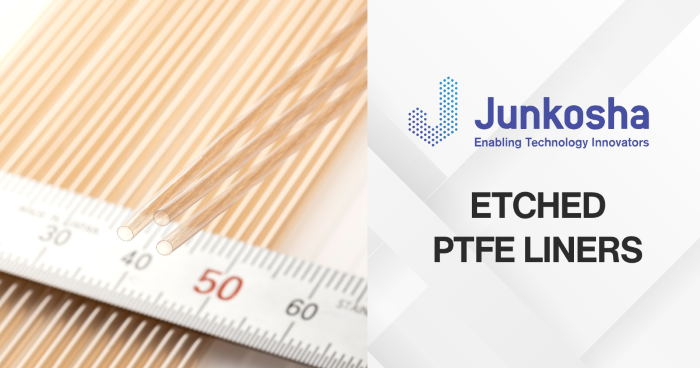
Post-treatment, the liner surface turns brown—a visual cue of successful surface activation essential for multilayer catheter construction.
Protecting Etched PTFE from UV and Handling Damage
Sodium-etched PTFE is highly sensitive to UV light. Prolonged exposure can degrade the activated surface, reducing bond strength.
Best practices include:
- Storing etched liners in sealed, black packaging
- Limiting exposure to light until point of use
Mechanical stress or contamination can also degrade surface quality. Junkosha addresses this by integrating automated inspection and packaging to reduce handling-related defects.
To request the SDS, please contact the Junkosha team here.
About the Supplier
Junkosha is dedicated to developing manufacturing technologies that enable consistent product quality, with a focus on extruded PTFE liners offering high tensile strength. Backed by patented proprietary technologies, their liners are tailored to customer-specific performance requirements, particularly for catheter systems demanding high mechanical performance, reliability, and scalability. Their automated inspection and packaging process further ensures stable adhesion and repeatable results across production volumes.
Browse Junkosha’s etched PTFE liners and peelable FEP heat shrink tubing on Chamfr.
Not finding what you’re looking for? Submit a custom RFQ directly to the Junkosha team, who is ready to help overcome your latest design challenges.
What dimensions are available?
The following size ranges are available for Junkosha’s Etched PTFE Liners on Chamfr: Inner Diameter: 0.010” to 0.130”, Wall Thickness: 0.00075” to 0.002”, Length: 40” to 80”.
Has the Junkosha Etched PTFE Liner been evaluated for biocompatibility?
Yes, the product is USP Plastic Class VI certified.
What are the recommended storage conditions for the Etched PTFE Liner?
Please store the product unpacked in a dark location at temperatures below 30°C (86°F), and humidity should not exceed 85% relative humidity.