
Quick-Release Glass-Filled PTFE Mandrels: 5 Game-Changing Benefits for Catheter R&D & Manufacturing

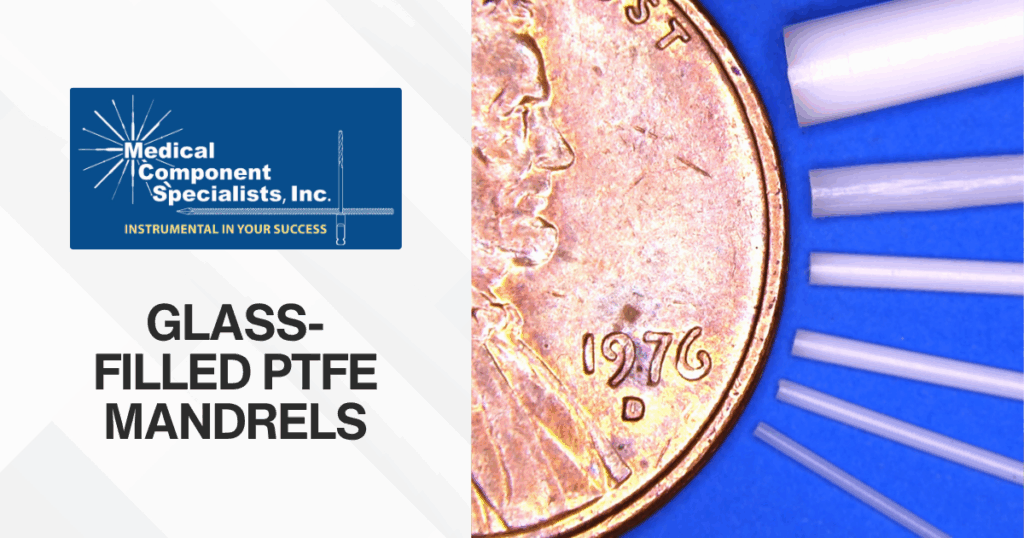
In this sponsored technical blog post, Medical Component Specialists explores the role of glass-filled PTFE mandrels in catheter manufacturing.
Mandrels play a vital role in catheter production, offering structural support, maintaining tight geometries, and ensuring a consistently accurate finished device.
Since entering the medtech industry in recent years, glass-filled PTFE mandrels have gained traction. But what exactly are they, what advantages do they offer, and where do they excel?
What are glass-filled PTFE mandrels?
These mandrels are produced through an extrusion process that incorporates glass fibers into PTFE. The result blends PTFE’s lubricity with the enhanced rigidity, durability, and dimensional consistency provided by glass fibers.
PTFE is a chemically inert, biocompatible fluoropolymer, and our independent testing reaffirms its safety—even in glass-filled form.*
What are the benefits?
- Precision tolerances
MCS offers custom-fabricated glass-filled PTFE mandrels with exceptional precision, with tolerances as tight as +/- 0.0002″.
- Easy removal
These flexible mandrels can be stretched to reduce their outer diameter, allowing for easy removal without harming the device. This improves yield and process efficiency.
- Quick turn-around
Chamfr has 90 SKUs of MCS glass-filled PTFE mandrels in stock, ready to ship in one to two days. Don’t see what you need in stock? Submit an RFQ.
- Cost efficiency
The per-unit cost of glass-filled PTFE mandrels is about half that of PTFE-coated stainless steel mandrels. In addition, easy removal leads to additional savings in reduced scrap and improved yield.
What are some key applications?
- R&D applications
If quick iterations and speed to market are paramount, glass-filled PTFE mandrels are an ideal choice. With more than 90 SKUs in stock on Chamfr—shipping in one to two days—these mandrels can help accelerate time to market.
- Microcatheter production
For small-scale devices like 1 Fr neurological microcatheters, stretching the mandrel for gentle removal helps avoid damage and maintain product integrity.
- Multilumen catheter manufacturing
When bonding balloons via heat, the low thermal mass of these mandrels ensures rapid heating and cooling, speeding production while maintaining yield.
With benefits like precision tolerances, higher yields, and faster production timelines, glass-filled PTFE mandrels are a valuable asset in any catheter manufacturing operation.

Choosing the right mandrel for your application
Whether you’re sourcing for prototyping or final production, selecting the right mandrel can significantly affect your finished device, yield, and time to market. Through Chamfr, engineers can access a curated selection of mandrels from Medical Component Specialists, Inc. and other verified suppliers.
About the Supplier
Medical Component Specialists, Inc. manufactures medical components like spinal wires, orthopins, mandrels, nitinol wire, cannulated drills, and staples for orthopedic and interventional applications. MCS has master grinding capabilities to ensure precision and unsurpassed quality while our CNC machining allows for high-volume production and flexibility to suit our customers’ diverse needs. Browse MCS’s mandrels, metal tubing, and polymer tubing on Chamfr.
* To receive cytotoxicity test data, contact us at info@medicalcomponentspecialists.com.
What is a glass-filled PTFE mandrel used for?
Glass-filled PTFE mandrels provide internal support during catheter assembly and release easily, even from soft, low-durometer materials.
How do glass-filled PTFE mandrels differ from regular PTFE?
They incorporate glass fibers to improve strength, dimensional stability, and reusability without sacrificing PTFE’s lubricity.
Can they be reused?
Yes, glass-filled PTFE mandrels are durable and can often be reused multiple times, depending on your process.
Are they biocompatible?
Yes. Testing confirms that even the glass-filled versions maintain the biocompatibility of PTFE.
What’s the advantage of stretchability?
Stretching reduces the mandrel’s diameter, making it easier to extract from delicate catheters without damage.