

 Share
Share
Rethink Your Heat Shrink
Material behavior, use cases, and design considerations when using flexible, thin-walled heat shrink tubing

Heat shrink decisions can look like a simple material choice in MedTech. But for R&D engineers, they can quietly drive redesign risk, wall thickness surprises, and unnecessary delays if they happen too late in development.
In our recent technical webinar, Barry Schnur, CEO of Cobalt Polymers, and Alex Miranda, Logistics Coordinator at Cobalt Polymers, joined Katie Karmelek, Co-Founder of Chamfr, to break down when Pebax and Polyolefin heat shrink may be the right fit, how these materials behave during recovery, and what engineers should evaluate before locking in a material or process.
The key takeaway is simple: better heat shrink decisions start earlier than most teams think.
Want to watch the full session? Sign up to access the webinar recording →
Why Heat Shrink Decisions Matter Earlier in Development
Some teams start the heat shrink conversation once a design is already moving toward validation, which is usually too late.
In the webinar, Barry shares that engineers often want something “just like FEP, but not FEP.” The issue isn’t that alternatives don’t exist. It’s that once teams are already deep into validated manufacturing processes, material changes are rarely simple. Recovery behavior, substrate compatibility, wall thickness, and handling all start to matter more once those decisions are locked in.
That creates a practical set of risks:
- Redesign work, which could have been avoided
- Wall thickness or recovery surprises
- Process assumptions that are harder to unwind later
- Unnecessary iteration
This is why heat shrink should be treated as an early development decision with downstream impact.
When Pebax and Polyolefin May Be the Better Fit
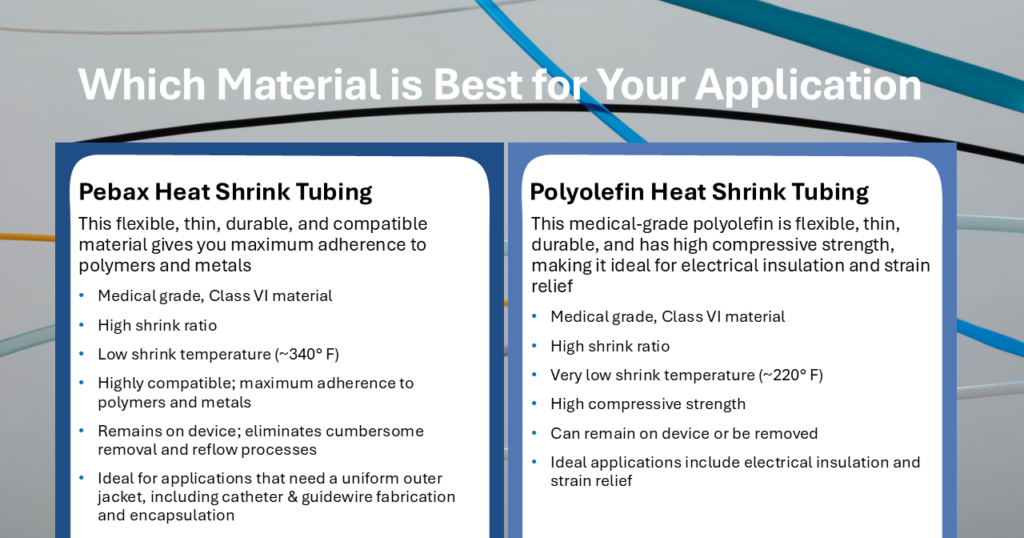
Pebax and Polyolefin heat shrink aren’t meant to solve the same problem in every build.
Pebax heat shrink is a strong fit when teams need a flexible, thin, durable material that can remain on the device and adhere well to polymers and metals. That makes it especially relevant for catheter and guidewire jacketing, encapsulation, and other applications where a uniform outer jacket matters.
Polyolefin heat shrink brings a different set of strengths. It’s also flexible and thin-walled, but with high compressive strength that makes it well suited for electrical insulation, strain relief, and related applications. Depending on the use case, it can remain on the device or be removed.
The larger takeaway is that the right material choice depends on the application, the finished device requirements, and how the tubing behaves in process. Jacketing, insulation, strain relief, encapsulation, bonding, termination, finishing, and marking each ask different things from medical heat shrink tubing.
How Recovery Behavior Affects Wall Thickness and Tolerances
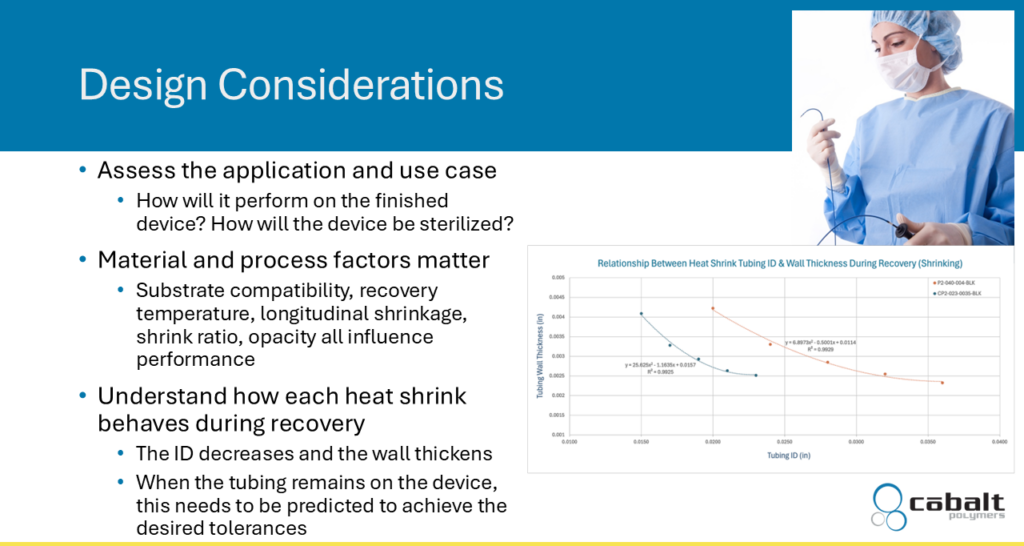
Recovery behavior is one of the most important parts of evaluating heat shrink tubing, especially when the material remains on the device.
As heat shrink recovers, the ID decreases and the wall thickens. That sounds straightforward, but it can become a real design issue when the final recovered wall thickness affects tolerances, flexibility, fit, or performance. If recovery isn’t predicted correctly, it becomes much easier to miss the results you were going for.
In addition to expanded size, engineers should consider:
- Substrate OD
- Target wall thickness
- Shrink ratio
- Recovery temperature
- How the tubing will behave across the full build
This is also where a lot of avoidable iteration starts. A size that looks right before recovery may not be the right answer once the tubing is actually on the device.
Where FEP Replacement Assumptions Break Down
One of the most useful parts of the session focused on a misconception that comes up often in catheter development: assuming Pebax heat shrink can simply replace FEP in the same process flow.
In practice, that’s harder than it sounds.
The challenge isn’t just the material. It’s the way the material behaves in the build. In braided shaft applications, for example, FEP often plays a very specific role in reflowing polymer through the braid and grabbing the liner underneath. Replacing that function is not as simple as swapping in another heat shrink.
Although certain materials can look like the right option on paper, they can still create problems once bonding, transitions, or process realities come into play. Evaluating those tradeoffs earlier helps reduce the risk of late-stage changes.
How Polyolefin Heat Shrink Handles in Application
During the discussion, Barry walked through a demonstration of Polyolefin heat shrink on a laser-cut hypotube.
It handled cleanly, showed flexibility, and reinforced a simple idea: easier handling and more predictable behavior make all the difference.
That kind of simplicity is easy to overlook, but it matters for teams trying to move quickly without introducing unnecessary complexity.
What This Means For R&D Teams
If you’re evaluating flexible, thin-walled heat shrink for your device, Pebax and Polyolefin are worth a closer look. But the right choice depends on recovery behavior, recovered wall thickness, and application-specific design considerations.
Watch the full session to learn:
- When Pebax and Polyolefin heat shrink tubing may be the right fit for your application
- How flexible, thin-walled heat shrink behaves during recovery
- Common medical device use cases for jacketing, strain relief, insulation, and protection
- Important design considerations when working across different substrates
- Practical methods for predicting recovered wall thickness