

Why Coating Process Control is Critical in Catheter Manufacturing


Process Control in Medical Device Coatings: Reducing Variability in Catheter Design
In this sponsored technical blog post, Applied Plastics explores how process control in PTFE coatings impacts dimensional consistency, assembly reliability, and performance across catheter components.
In medical device design and manufacturing, tight tolerances are essential to ensure device performance and patient safety. This is especially true for coated tooling and functional components, where coating thickness and dimensional consistency directly influence device assembly and operation.
Even small variations in coating thickness can create downstream issues, including difficulty removing catheters from mandrels, fit inconsistencies during assembly, and variability in device performance during testing. These issues often surface during builds, leading to redesign, rework, or delayed validation.
Process control helps reduce this variability by ensuring coatings behave consistently across prototypes and production runs, supporting more reliable assembly and device performance.
Mandrels and Tooling
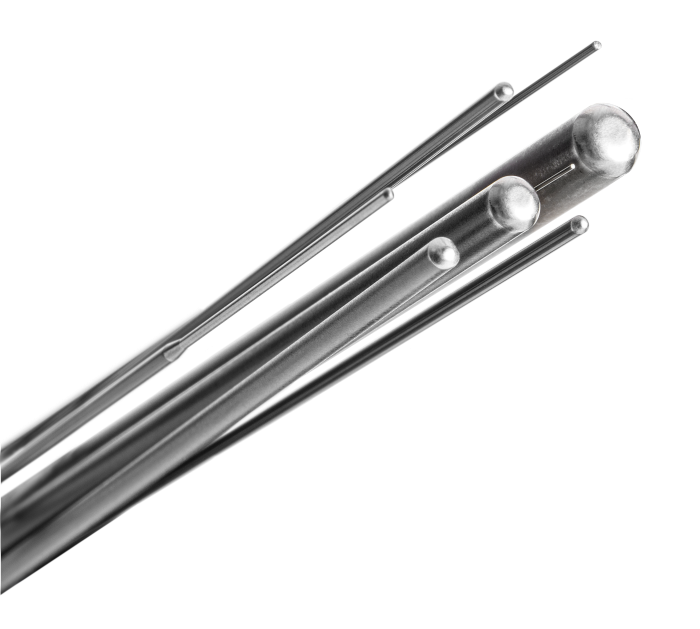
Mandrels are fundamental to catheter manufacturing and are typically produced from stainless steel or other metal substrates. During catheter assembly, the liner, braid, intermediate functional layers, and outer jacket are layered onto a mandrel and thermally fused.
Once the assembly process is complete, the catheter must be removed without damaging the internal liner or the integrity of the structure. For this reason, mandrels are commonly coated with a low-friction coating, like PTFE.
Due to the tight spacing in catheter design, the outside diameter (OD) size and tolerance of the mandrel are critical. Even minor variations can affect layer bonding, final dimensions, and catheter removal.
Controlling coating thickness on mandrels helps:
- Avoid fit and clearance issues during assembly
- Reduce risk of damaging internal layers during removal
- Improve consistency of final catheter dimensions
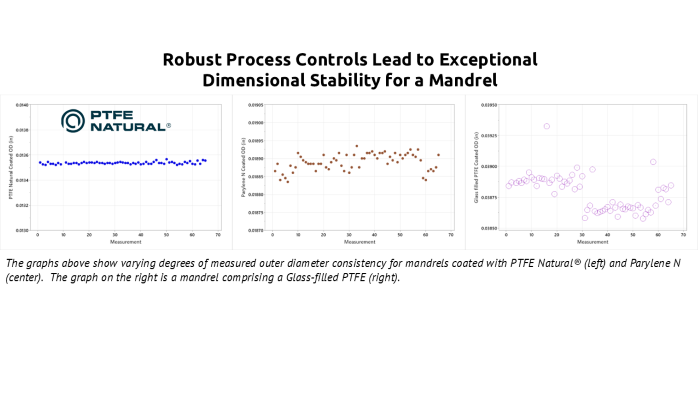
To achieve this, the coating layer must maintain tight tolerances without compromising performance. Applied Plastics has optimized its PTFE coating processes, with PTFE Natural® designed to deliver low friction and durability alongside consistent dimensional control.
Compared to alternative coatings, PTFE Natural® demonstrates strong dimensional consistency, helping maintain the tolerances required for precision tooling.
Catheter Components
With limited space inside catheter designs, coating process control becomes especially important in assemblies like pull ring systems. Pull wires must operate within extremely tight dimensional constraints, directly affecting both assembly and device performance.
Variability in coating thickness can:
- Increase friction during assembly
- Create challenges routing wires through lumens
- Lead to inconsistent mechanical response during testing
Controlling coating consistency helps:
- Reduce redesign driven by coating variability
- Improve consistency across builds
- Avoid repeated assembly adjustments to resolve friction issues
Durable, low-friction coatings enable smoother, more repeatable performance while improving assembly efficiency by allowing wires to feed more easily through catheter lumens.
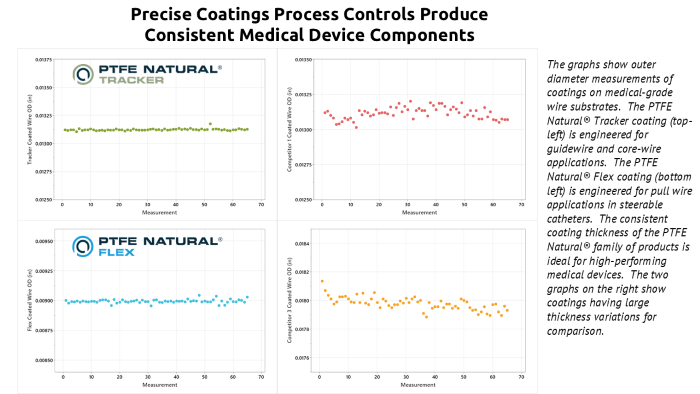
As device profiles continue to shrink, maintaining dimensional control becomes more critical. Coatings like PTFE Natural® Flex are engineered for pull-wire applications, supporting consistent coating thickness and repeatable performance from early prototypes through production.
Guidewires and Delivery Systems
Guidewires and delivery systems must navigate tortuous vasculature while maintaining control and responsiveness. They also support the delivery and exchange of therapeutic devices.
Inconsistent coating performance can:
- Reduce tactile feedback
- Impact trackability through complex anatomy
- Introduce variability during device delivery
Maintaining both lubricity and dimensional consistency helps:
- Improve consistency in device response during navigation
- Reduce variability in delivery performance
- Support more reliable interaction between devices and guidewires
PTFE Natural® Tracker is designed to support these requirements, providing low friction, durability, and controlled coating thickness to help maintain consistent responsiveness during use.
How Process Control Reduces Variability in Device Development
By tightly controlling coating thickness and consistency, R&D engineers can reduce variability across builds and testing.
This enables teams to:
- Reduce tolerance-related build issues and avoid fit inconsistencies
- Reduce redesign driven by coating variability
- Improve consistency across test samples and device performance
From mandrels and tooling to pull wires and guidewires, coatings play a direct role in assembly and performance.
When coating variability is controlled, teams spend less time addressing inconsistencies and more time progressing the design, faster.
FAQs
What is PTFE coating in medical device manufacturing?
PTFE coating is a low-friction fluoropolymer coating applied to medical device components such as mandrels, guidewires, pull wires, and hypotubes. It reduces friction, improves durability, and helps maintain dimensional consistency, allowing catheter components to move smoothly during assembly and clinical use.
Why is process control important in medical device coating applications?
Process control ensures coatings are applied with consistent thickness, adhesion, and surface performance. In medical device manufacturing, even small variations can affect assembly, device function, and patient safety. Precise control of coating parameters helps manufacturers maintain tight tolerance and predictable device performance.
How does coating thickness affect catheter manufacturing?
Coating thickness directly influences the dimensional tolerances of catheter components and tooling. If the coating thickness varies, it can alter the catheter’s internal diameter or interfere with component assembly. Consistent coating thickness helps maintain device geometry and supports reliable catheter performance.
Why are mandrel coatings important in catheter manufacturing?
Mandrels serve as internal tooling around which catheter layers are assembled and fused. A low-friction coating, such as PTFE, allows the finished catheter to be removed without damaging the internal liner or structure, while maintaining tight inner-diameter tolerances.
Why are low-friction coatings important for catheter components?
Low-friction coatings reduce resistance between catheter components, improving device assembly, actuation, and navigation through tortuous anatomy. These coatings help enable smooth pull-wire movement, reliable guidewire responsiveness, and easier catheter removal from mandrels during manufacturing.
What challenges do pull-wire coatings solve in steerable catheters?
Pull wires operate within extremely tight dimensional constraints while enabling precise catheter steering. Low-friction coatings reduce resistance, improve assembly efficiency, and help prevent friction-related wear or failure inside catheter lumens.
Why is dimensional consistency critical for guidewire coatings?
Guidewires must navigate complex anatomy while supporting the delivery and exchange of therapeutic devices. Consistent coating thickness ensures predictable responsiveness, smooth device movement, and reliable tactile feedback for the physician during procedures.
About Applied Plastics
Applied Plastics is a leading supplier of PTFE-coated products used in the design and manufacturing of advanced catheter systems. Its PTFE Natural® coating family offers a low coefficient of friction, high durability, and thermal stability, supporting consistent performance across demanding applications.
Explore over 250 in-stock PTFE-coated mandrels and hypotubes from Applied Plastics on Chamfr, ready to ship in one to two business days, or submit an RFQ for custom solutions.