

PTFE: Proven Performance, Rising Constraints in Catheter-Based Medical Devices

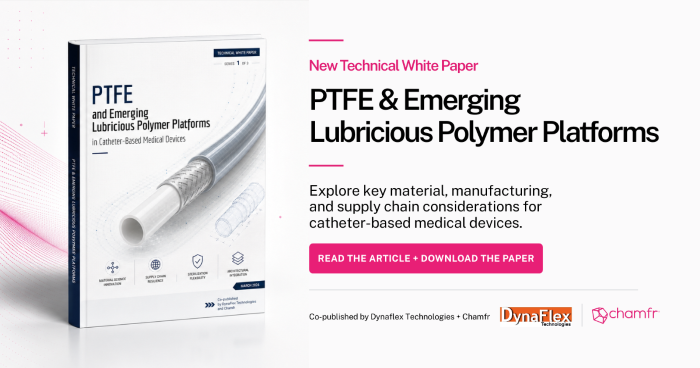
In this sponsored technical blog post, Dynaflex Technologies provides an overview of PTFE performance, supply chain concentration dynamics, sterilization constraints, FDA material-change guidance, and emerging lubricious polymer platforms with an in-depth white paper download.
Overview of PTFE
PTFE has been a foundational material in catheter-based medical devices for over five decades, and for a good reason. Its ultra-low coefficient of friction, chemical inertness, and established biocompatibility have made it a default liner material across a wide range of interventional device applications.
For many MedTech R&D teams, PTFE isn’t just familiar. It’s the default. But familiarity can create blind spots.
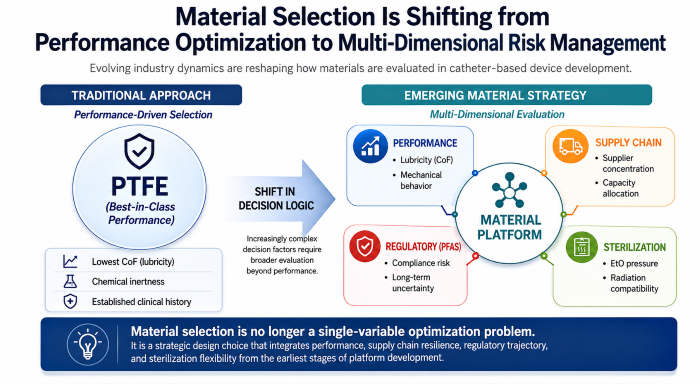
Catheter material selection is no longer just a question of lubricity. It’s a strategic design choice integrating performance, supply chain resilience, regulatory trajectory, and sterilization flexibility from the earliest stages of platform development.
Without that broader view, teams may miss constraints that only become visible when they’re hardest to fix later on.
Download the Dynaflex PTFE White Paper →
Why PTFE Became the Standard for Cather-Based Devices
PTFE earned its role in medical device development with a rare combination of material properties:
- Surface characteristics that support low-friction performance
- Chemical inertness across demanding applications
- Established biocompatibility and clinical history
- Thin-wall capability for profile-sensitive catheter designs
For engineers and regulatory teams, that history provides a familiar foundation that can be difficult to replace.
But a material choice based on one performance variable can still create downstream constraints that shape the catheter platform over time.
Industry Signals Are Changing the Material Selection Conversation
The shifts in the operating environment for medical device material selection are becoming harder to ignore.
What was once a straightforward choice for many MedTech teams now sits at the intersection of performance, sourcing, supply chain, sterilization, and regulatory planning.
Several converging industry signals reinforce a structural shift in how material decisions are being made:
- 3M’s completed exit from all PFAS manufacturing by the end of 2025 has concentrated medical-grade PTFE supply among three primary manufacturers — two headquartered in Japan.
- W. L. Gore & Associates — ePTFE’s defining innovator — has publicly committed to transitioning its consumer fabrics portfolio away from ePTFE toward expanded polyethylene (ePE). The signal from the company that invented the material is directionally significant.
- The FDA held a dedicated webinar on December 10, 2025, providing a structured, least-burdensome framework for PTFE material changes in 510(k) devices — clarifying that thorough documentation may support a material transition without a full new submission.
- The EtO sterilization landscape faces sustained long-term regulatory pressure, while PTFE’s fundamental susceptibility to radiation-induced chain scission limits its compatibility with gamma and e-beam alternatives.
Together, these signals change the material selection question. PTFE may still be the right liner material for many catheter programs, but the decision should be evaluated with broader constraints in mind.
Where Narrow Material Selection Can Create Downstream Risk
When liner selection starts and ends with lubricity, important constraints can move too far downstream.
Sterilization flexibility: A material strategy that works well for one sterilization pathway may create limitations if the program later needs to evaluate another. For long-lifecycle platforms, that can affect planning, qualification, and future manufacturing flexibility.
Bonding and interface risk: Catheter construction often depends on multiple layers, materials, and process steps working together. A liner material can perform well on its own while still adding complexity at the interface. If those risks are not evaluated early, teams may encounter process variability, delamination concerns, wall budget pressure, or yield loss later.
Supply chain resilience: For catheter platforms expected to remain in market for years, material selection is also a sourcing decision. Limited supplier optionality can make qualification planning, alternate sourcing, and long-term supply strategy more difficult.
Regulatory planning: Even when a material change may not require a new submission, teams still need a clear technical rationale, risk assessment, and documentation strategy. The earlier those considerations are understood, the easier it is to preserve flexibility.
These factors expand what performance means in terms of what the material enables, limits, or complicates across the full device lifecycle.
Download the White Paper
Dynaflex Technologies provides a technically grounded review of PTFE’s:
- Performance profile and structural limitations
- Supply chain concentration dynamics
- Sterilization compatibility constraints
You’ll also learn more about the FDA’s evolving guidance on material change submissions and the characteristics of alternative lubricious polymer platforms, focusing on where current-generation material science has arrived after more than a decade of formulation development.
Download the white paper to make more strategic material decisions across catheter design, sourcing, supply chain, sterilization, and regulatory planning.
About the Supplier
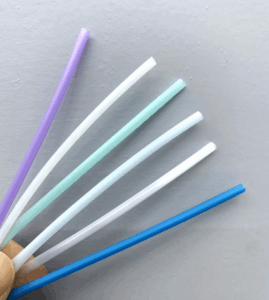
Dynaflex Technologies is a trusted medical device contract manufacturer specializing in catheter solutions, extrusion polymer expertise, and equipment solutions. With global operations and innovative PFAS-free materials, they deliver reliable, high-quality, and sustainable manufacturing services.
Explore Dynaflex’s in-stock polymer tubing to move faster, or submit an RFQ for custom solutions built for your next catheter innovation.