

High-Performance 304V & 304NX Braid Wire From Heinrich Stamm GmbH Available Now

Every decision in early-stage medical device R&D carries weight, especially when it comes to choosing materials that define the performance of your design. From catheter reinforcement to implant delivery, the wire you select can accelerate development or delay it entirely.
Now, with more precision braid wire options available on Chamfr, R&D teams can reduce lead times, increase flexibility in design, and move prototypes forward faster.
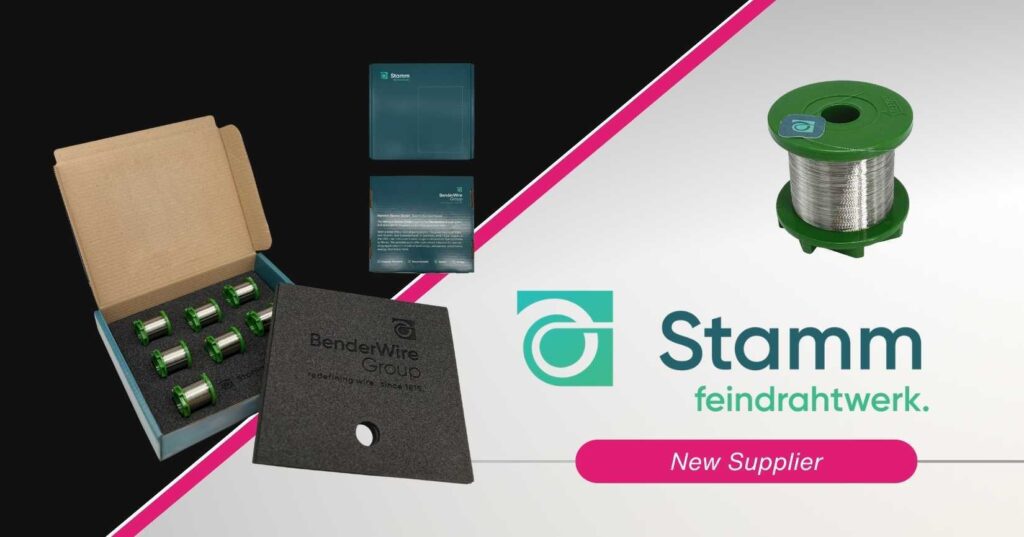
Heinrich Stamm GmbH, a MedTech wire specialist and part of the BenderWire Group, has added a new collection of 304V and 304NX stainless steel braid wire to the Chamfr marketplace. Sold in ready-to-use Steeger, 30mm, 8-bobbin sets, these products are tailored for early-stage builds, giving engineers direct access to high-performance materials without sourcing delays or bulk order requirements.
Why Braid Wire Matters in Medical Device Prototyping
Braid wire isn’t just a reinforcement layer, it’s a critical design enabler.
In catheter shafts, delivery systems, and implantable tools, braid wire directly impacts pushability, torque transmission, kink resistance, and wall profile. For engineers in early development, the ability to test different diameters, tensile strengths, and material types is essential to refining performance and proving feasibility.
Chamfr now makes that process faster and easier by stocking a broader range of medical-grade braid wire in small R&D-ready formats.
Engineered for Prototyping: What Sets Braid Wire Apart
When you’re iterating quickly, material precision and availability matter.

The newly available braid wire stands out by giving R&D teams:
- Medical-grade alloys: Available in 304V and 304NX, both known for their proven biocompatibility, corrosion resistance, and mechanical strength.
- Tight diameter tolerances: Down to 0.000433”, enabling uniform braiding and consistent OD/ID control.
- Multiple tensile strengths: From very hard (325 ksi) to ultra-hard (>520 ksi), so you can tailor flexibility, torque response, or kink resistance.
- R&D-optimized packaging: Supplied in Steeger, 30mm, 8-bobbin sets, ideal for quick-turn prototypes and small-batch feasibility builds.
- ISO-certified and Made in Germany: Every meter is produced in-house, ensuring full process control, traceability, and performance reliability.
These attributes give R&D teams more control over mechanical performance while enabling faster prototype cycles.
Use Cases: How R&D Teams Are Applying Braid Wire
From neurovascular systems to structural heart implants, braid wire plays a central role in device function.
| Use Case | Why It’s a Fit |
| Catheter shafts | Enables tight braiding, precise OD control, improved torque and pushability |
| Delivery systems | Ultra-hard tensile options support aggressive wall reductions and high stiffness |
| Implant delivery | Provides radial strength and mechanical reliability during navigation |
| Microcatheters | Ultra-fine wire diameters minimize device profile while maintaining performance |
| Hybrid constructions | Supports braid + coil or multi-durometer layering with fine tolerances |
Having the flexibility to choose between 304V vs. 304NX allows R&D teams to fine-tune shaft mechanics, test alternatives quickly, and move toward clinical readiness with confidence.
Material Comparison: 304V vs. 304NX
Different device functions demand different material properties.
This wire collection includes two trusted stainless steel grades, both proven in medical applications, but with distinct advantages:
| Property | 304V | 304NX |
| Biocompatibility | Excellent | Excellent – engineered for consistency in high-strength medical builds |
| Corrosion Resistance | High | High – maintains performance under mechanical stress and deformation |
| Use Cases | General catheter, guidewire | High-performance shafts, neurovascular devices, torque-critical systems |
| Form | Vacuum-melted | Cold-drawn with controlled grain structure for ultra-high tensile strength |
If you’re prototyping short-term delivery tools or guidewires, 304V offers reliable mechanical strength, biocompatibility, and corrosion resistance. For designs that demand higher tensile strength, like neurovascular catheters, torque shafts, or thin-walled delivery systems, 304NX delivers enhanced durability and stiffness, making it ideal for engineers pushing performance limits in compact device architectures.
Build a Complete Solution with Chamfr

Chamfr is your one-stop shop for catheter and delivery system development. In addition to braid wire, we stock etched PTFE liners, polyimide tubing, Pebax heat shrink tubing, and mandrels, everything you need to build and test braided shafts. No MOQs, fast shipping, and components that are engineered to work together. Get what you need to prototype faster, all in one place.