

 Share
Share
Optimizing OEM-CDMO Collaboration for Smoother MedTech Scale-Up
Best practices for bridging R&D and manufacturing to reduce rework, improve handoffs, and accelerate medical device development.
The move from medical device R&D to manufacturing is rarely as simple as sending over a drawing and asking for a quote.
When expectations are unclear, small gaps can turn into bigger issues later: supplier misalignment, unclear ownership, late DFM feedback, tolerance challenges, inspection questions, and rework that could have been avoided.
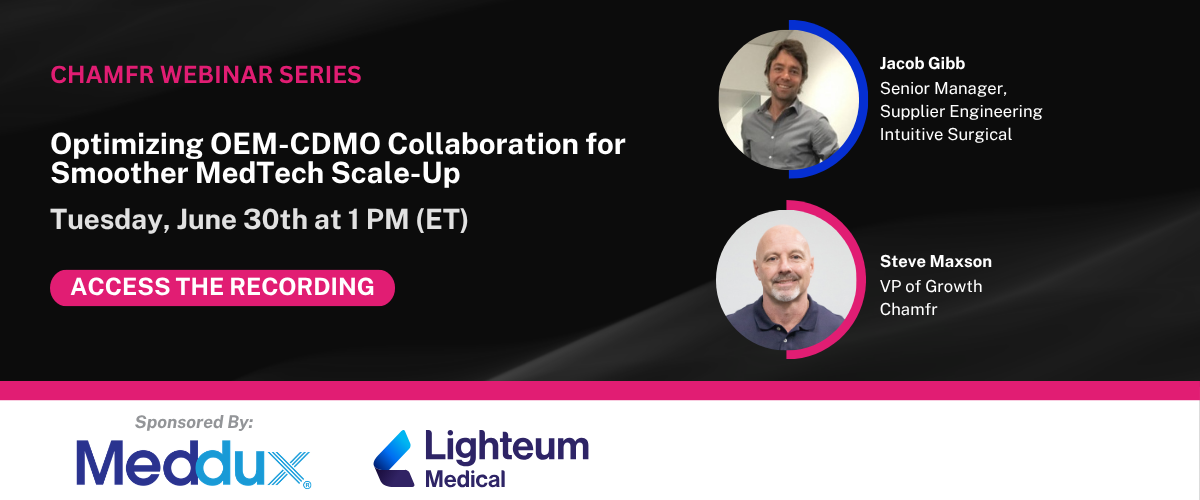
In this webinar, Jacob Gibb, Senior Manager, Supplier Engineering at Intuitive Surgical, joined Steve Maxson, VP of Growth at Chamfr, for a practical discussion on how OEMs, CDMOs, suppliers, and R&D teams can collaborate more effectively before scale-up pressure hits.
The conversation focused on a core shift: moving from transactional quoting to more useful technical collaboration earlier in development.
Want to watch the full session? Sign up to access the webinar recording →
Why OEM-CDMO Alignment Matters Before Scale-Up
Throughout the discussion, a recurring theme was that many OEM-CDMO challenges start before development work gets very far.
R&D teams may still be exploring options. Suppliers may assume the drawing is final. CDMOs may not know whether the OEM needs parts, process expertise, design input, or broader manufacturing support.
That mismatch can create friction later.
In the webinar, Jacob and Steve discussed why teams need to clarify key expectations upfront, including:
- What the supplier or CDMO is actually being asked to solve
- Whether the design is fixed or still open to input
- Who owns design input, process knowledge, and deliverables
- What information can be shared to help suppliers make better recommendations
- How the relationship may need to change as a program moves from R&D toward production
The earlier those expectations are clear, the easier it is to avoid rework, delays, and handoff confusion later.
From “Quote the Print” to Better Technical Collaboration
One of the strongest points from the discussion was that supplier conversations should not always start and stop with the drawing.
There are times when quoting a print is exactly what’s needed. But in early development, the better question may be: what are we still trying to learn?
If a design isn’t locked, supplier and CDMO input can help teams pressure-test assumptions before they become expensive to change. That may include manufacturability feedback, alternate approaches, material or process considerations, and practical guidance based on similar applications.
The full webinar explores how R&D teams and suppliers can have more productive early conversations without creating unnecessary noise or slowing down development.
Giving Suppliers Enough Context to Add Value
Jacob also emphasized that suppliers can provide better input when they understand the intended use, application, workflow, interfaces, and development stage of the part or assembly.
That does not mean sharing confidential details that should stay protected. But even high-level context can help a CDMO understand what the part needs to do, where it interfaces with other components, and which requirements may matter most.
This is where collaboration becomes more practical.
A supplier with deep process expertise may be able to flag risks, suggest a different approach, or identify a manufacturability concern earlier. But that only happens when they have enough context to understand the real problem, not just the dimensions on the print.
Where DFM, Inspection, and Process Capability Enter the Conversation
As the discussion moved closer to scale-up, Jacob and Steve dug into the role of DFM, inspection expectations, tolerances, repeatability, and process capability.
This is where small assumptions can become expensive.
A prototype may meet the drawing, but that does not always mean the process is ready to scale. Measurement methods may not be aligned. Critical dimensions may be harder to hold consistently than expected. Inspection expectations may not be clear until too late.
The discussion explores why these conversations should happen earlier, especially when teams are working with challenging tolerances, critical features, or processes that need to become repeatable over time.
Overall, the takeaway is not to turn every early build into a full production validation. It’s to use supplier expertise earlier so teams can identify the right risks before they become harder to fix.
What This Means for R&D Teams
For R&D engineers working across OEMs, CDMOs, suppliers, and manufacturing partners, smoother scale-up often starts with better questions earlier in development.
Before the design is locked, teams should be thinking about:
- What still needs to be learned from the next prototype or build
- Where supplier input could improve the design or process
- Which tolerances, inspection methods, or critical dimensions may create risk later
- Whether the selected partner is best suited for R&D speed, production scale, or both
- How to make handoffs clearer before manufacturing pressure increases
The full conversation gives a practical perspective on how to improve those handoffs, reduce late-stage surprises, and create a smoother path from prototype to production.
Access the Full Webinar Recording
Watch the full session to hear Jacob Gibb’s perspective on OEM-CDMO collaboration, early supplier involvement, DFM conversations, and inspection expectations for smoother MedTech scale-up.