

 Share
Share
DOE in Action: Reducing Trial-and-Error in Product Development
A practical example of using data-driven experiments to streamline medical device process development and make faster, smarter product decisions.
Medical device R&D teams are often balancing many variables at once: materials, additives, coating options, process settings, performance targets, and application-specific requirements.
Testing every possible combination is usually not realistic.
In this webinar, Dr. David Kissel, Director of R&D at Applied Plastics, joined Katie Karmelek, Co-Founder of Chamfr, for a practical discussion on how Design of Experiments (DOE) can help teams reduce trial-and-error and make better product development decisions earlier.
While the discussion showed DOE in action with a coating color development example, the broader takeaway applies well beyond color. When teams define the right questions, choose the right variables, measure meaningful responses, and interpret the data carefully, DOE can help them learn more from fewer runs.
Want to watch the full session and download the DOE Starter Kit? Sign up to access the webinar recording and PDF →
Why DOE Matters in Medical Device Product Development
In early-stage medical device development, teams need to make smart technical decisions fast. That can be difficult when there are multiple variables and tradeoffs influencing the final result.
A one-variable-at-a-time approach can work for simple questions, but it becomes inefficient when variables interact.
DOE creates a more structured way to learn. Instead of testing every possible combination, teams can design experiments that reveal which variables matter, which interactions may be important, and where additional testing should focus.
Key takeaway: DOE helps product development teams move from trial-and-error toward structured learning, especially when there are too many variables to compare efficiently.
Start With the Development Decision, Not the Experiment
The first question shouldn’t be “What DOE should we run?” It should be “What decision are we trying to make?”
That decision may be to narrow material options, select top candidates, understand tradeoffs, identify performance drivers, verify an assumption, or plan follow-up testing. Without that clarity, teams risk creating an experiment that generates data that doesn’t support a useful next step.
FMEA can be a helpful starting point because it already captures known risks, possible failure modes, and areas of uncertainty. If something has been ranked as a high-risk item, or if the team is unsure whether a risk is being driven by another variable, DOE can help pressure test those assumptions.
Strong planning also depends on collaboration. Subject matter experts, engineers, operators, and other stakeholders should all work together to identify what matters most before the DOE is built.
Use Screening to Avoid Wasted DOE Runs
Screening work can help teams avoid spending time and resources on experiments that are not yet ready.
Before building a formal DOE, teams may need to confirm that materials can mix, equipment can operate within the planned range, or the proposed test conditions can produce something measurable and consistent.
For example, if a team is testing a new chemistry, it may be worth confirming basic compatibility before assigning that combination as a DOE run. If a team is evaluating extrusion or injection molding conditions, it should first confirm that the selected temperature or process window is realistic for the material and equipment.
This upfront work helps prevent wasted data points and keeps the formal DOE focused on conditions that can actually support learning.
Coating Color Shows How DOE Turns Visual Differences into Measurable Data
Color is a useful DOE example because it’s easy to see, but not simple to control.
In Dave’s coating color development example, each sample produced a different visual result. But the important step was turning those visible differences into measurable data. In the webinar, he walked through sample swatches alongside average RGB values, showing how color can be evaluated with more structure than visual judgment alone.
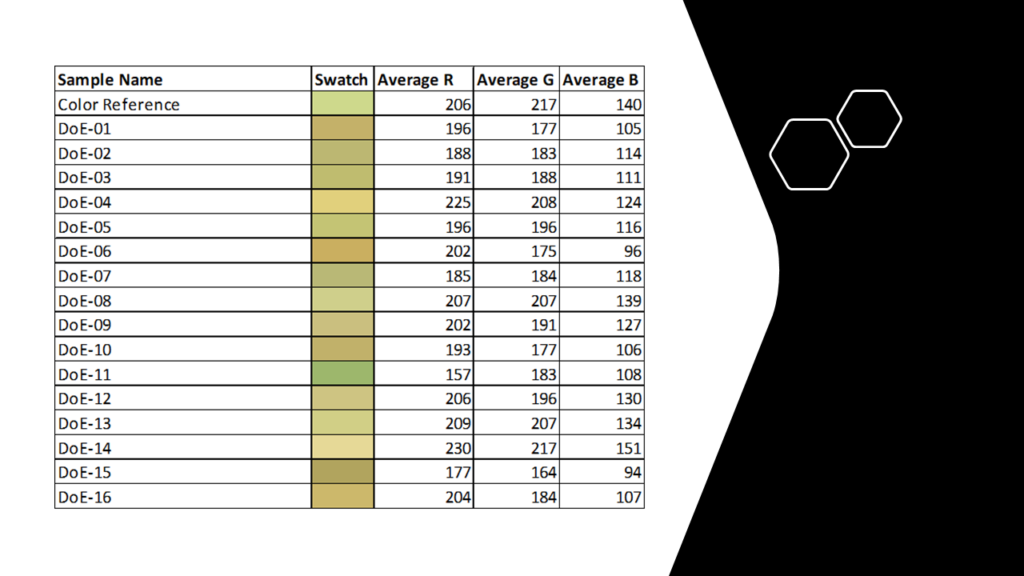
Color can also have tolerances, similar to dimensional specifications like ID or OD. Instead of a plus/minus dimensional window, color difference can be evaluated using Delta E, which measures the distance between a sample color and a reference color.
Overall, samples that appear similar may still have measurable differences, which can become more noticeable depending on hue and tone.
Process DOE vs. Mixture DOE: Why Proportions Change the Model
A traditional process DOE typically changes variables such as time, temperature, speed, pressure, or line speed, which can often be moved independently.
A Mixture DOE is different because the inputs are components of a whole. If one ingredient or component changes, the others must change around it because the total still needs to add up to 100%.
That proportionality changes how the experiment should be designed and interpreted. If a true mixture problem is treated like a standard process DOE, the model may point teams toward false positives, false negatives, or conclusions that do not match how the system actually behaves.
Make DOE Results Actionable with the Right Responses
Choosing inputs is only part of the challenge. The team also needs to define useful responses.
A response should connect back to the development decision the DOE is meant to support. In medical device development, that might mean cosmetic appearance, adhesion, flow stability, friction, lubricity, abrasion resistance, wetting angle, hardness, or another application-specific performance need.
Some responses are easier to measure than others. Color can be measured through coordinate systems. Friction can be tested. Adhesion can be evaluated. But other responses, like surface feel or scratch behavior, may require a structured rating system.
A simple pass/fail may not provide enough granularity to model the response. A 1–10 rating system can give teams more useful data than a 1–3 scale, especially when the goal is to compare trends across multiple experimental conditions.
Use DOE to Balance Tradeoffs, Not Just Find a Winner
Dave also walked through contour plots and response optimization tools, which help teams see where performance targets overlap.
For example, showing how different formulation regions could support different combinations of color, friction, and abrasion performance.
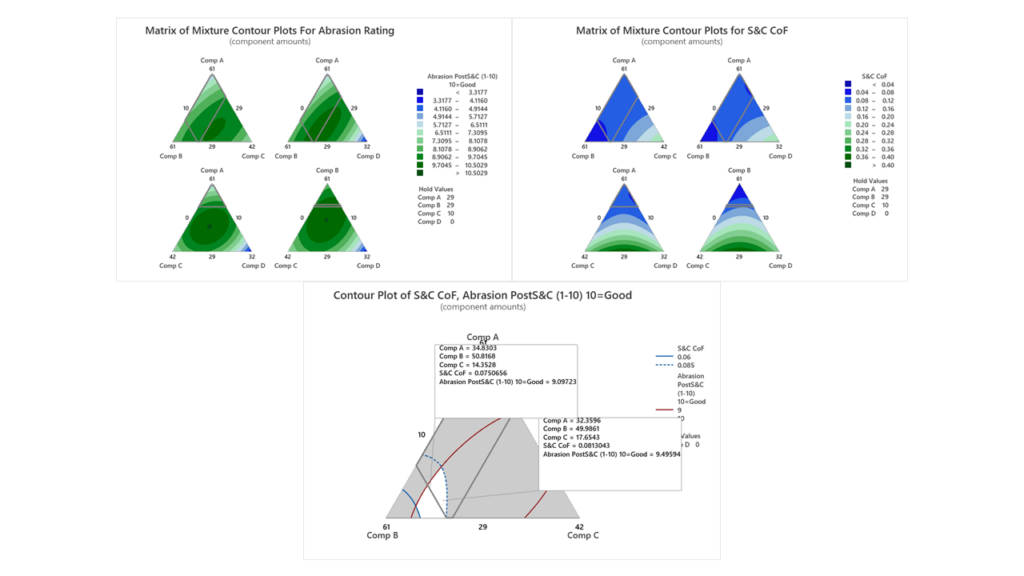
The best answer is not always the theoretical maximum. If the acceptable region is only a tiny sliver, normal variation may push the result out of range. A more stable region with enough tolerance or leeway may be more useful for real product development.
Engineering judgment remains critical. While data can point teams in the right direction, follow-up testing is still an important step.
It gives teams a stronger structure for using that judgment and deciding what to test next.
Reduce Test Runs Without Losing the Learning
One of the practical benefits of DOE is the ability to reduce testing burden while still preserving useful learning.
In the coating color example, the full candidate design space included 36 possible design points, but the selected D-optimal design used 16 design points. The model terms included A, B, C, D, and two-way interactions such as AB, AC, AD, BC, BD, and CD.
This type of reduction comes with tradeoffs. A smaller design may give up some detail, such as higher-order interactions. But when time, material, equipment, or resources are limited, it can be a practical starting point.
The first DOE does not need to answer every question right away. It can narrow the space, identify promising regions, and guide follow-up runs that confirm or refine the model.
What This Means for R&D Teams
For R&D engineers and product development teams, DOE is most valuable when it is treated as a practical decision-making tool.
It’s not about testing everything. It’s about structuring the experiment so you can learn enough to make a better next decision.
While the session’s coating color example made the method visible, the same thinking can apply across many medical device development challenges, including polymer compounding, extrusion, catheter liners, composite catheter shafts, braiding, coating performance, friction, and lubricity.
The biggest shift is moving from “try it and see” to a more structured learning process: define the decision, choose the right variables, measure meaningful responses, understand the tradeoffs, and use the data to make the next development step clearer.
Access the Full Webinar Recording and DOE Starter Kit
Want to dive deeper into the full technical discussion? Access the recording to see the coating color DOE example in action and learn how structured experiments can help your team narrow variables, reduce unnecessary testing, and make clearer product development decisions earlier.
You can also download the DOE Starter Kit, a practical resource to help teams think through experiment planning, DOE approach, measurable responses, constraints, and common pitfalls before running tests.