

Where Pebax® and Polyolefin Heat Shrink Tubing Fit in Medical Device Design

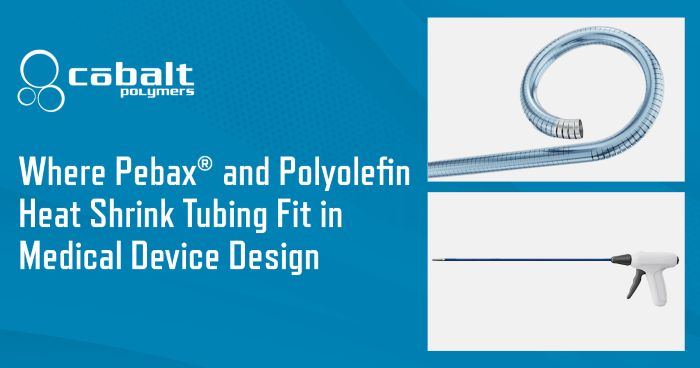
In this sponsored technical blog post, Cobalt Polymers shares where Pebax® and Polyolefin Heat Shrink Tubing fit in medical device design, including applications for laser-cut hypotube jacketing, electrical insulation, and four additional use cases in an in-depth guide.
Why Heat Shrink Material Behavior Matters
When engineers specify heat shrink tubing, they often start with the materials and processes they already know. FEP, PET, Pebax®, and Polyolefin all have established roles in medical device design and manufacturing, so that decision makes sense.
But similar applications do not always mean similar behavior.
The way heat shrink tubing recovers, bonds, conforms, or responds to the substrate can change how it performs in the final device or during assembly. That is especially important when the tubing needs to support flexibility, super-thin walls, dimensional control, or other performance requirements.
Pebax® and Polyolefin Heat Shrink Tubing are not replacements for every material or every process. But in the right application, they can create opportunities to simplify construction, reduce material layers, or solve performance challenges that may not be obvious.
Learn more about where Pebax® and Polyolefin Heat Shrink Tubing fit and what to consider before selecting a material, heat shrink ratio, or wall thickness in Cobalt Polymers’ technical guide.
Pebax® Heat Shrink Tubing for Laser-Cut Hypotube Jacketing
As catheter construction continues shifting toward laser-cut hypotubes, engineers are looking for ways to maintain flexibility while simplifying shaft construction.
In many designs, Pebax® Heat Shrink Tubing functions as the outer layer of the shaft while remaining flexible enough to preserve the underlying laser-cut hypotube pattern. Because the heat shrink will thermally bond during recovery, it can eliminate the need for adhesive layers or secondary bonding processes.
Polyolefin Heat Shrink Tubing for Electrical Insulation
Electrical insulation applications require more than simple coverage. The tubing must maintain consistent isolation while withstanding flex, compression, and handling.
Polyolefin Heat Shrink Tubing offers high dielectric and compressive strength, helping maintain consistent electrical isolation while providing uniform contact with conductive components.
Download the Technical Guide
In the full guide, take a deeper look at these applications, along with four additional use cases for Pebax® and Polyolefin Heat Shrink Tubing.
Download to learn more about material selection, behavior, shrink ratio, wall thickness, and process considerations.
Explore Cobalt Polymers Heat Shrink R&D Kits on Chamfr
If you’re evaluating materials for a catheter, guidewire, electrosurgical device, or other minimally invasive application, you can also explore Cobalt Polymers’ tubing directly on Chamfr.
In addition to more than 35 in-stock SKUs, Cobalt recently introduced two heat shrink tubing kits designed to help engineers iterate faster across different shrink ratios, materials, and sizes.
- Pebax® and Polyolefin Heat Shrink Kit, 2:1 Shrink Ratio, Various Sizes < 0.040″ Expanded ID, Qty: 14 pieces
- Pebax® and Polyolefin Heat Shrink Kit, 4:1 Shrink Ratio, Various Sizes 0.040″ – 0.360″ Expanded ID, Qty: 14 pieces
Related Resource: Watch the Heat Shrink Webinar
Want a deeper look at Pebax® and Polyolefin Heat Shrink Tubing material behavior, use cases, and design considerations?
Watch Chamfr’s webinar with Cobalt Polymers to make better decisions earlier in development.
Read the recap and access the recording →
About Cobalt Polymers
Cobalt Polymers manufactures flexible, durable, thin-wall heat shrink tubing in Pebax® and Polyolefin. Located in Healdsburg, Calif., Cobalt Polymers is ISO 13485:2016 certified and has been producing medical-grade tubing for many of the world’s most innovative medical device manufacturers since 2001.
Have questions about your application? Cobalt’s technical team can collaborate with you on material selection, shrink ratios, wall thickness, and process considerations as you evaluate options for your device.