
Single-Lumen Tubing
For catheter shafts, fluid paths, liners, and prototype applications where one channel is sufficient.
BROWSE SINGLE-LUMENR&D engineers go to Chamfr first to explore, compare, and buy polymer tubing. With in-stock availability, make-to-order options and custom RFQ sourcing paths, engineers can move from early material evaluation to sourcing without jumping between multiple supplier sites and get to design freeze faster.
Chamfr gives R&D engineers a stronger starting point than a single supplier site: one marketplace to compare all available tubing options, evaluate supplier fit, buy prototype quantities, and submit custom RFQs when the exact size, material, or construction is not listed.
Explore materials, constructions, sizes, and qualified suppliers without jumping between multiple websites.
Find prototype-ready and small-quantity tubing options for feasibility builds and design iterations.
Buy all available options or request custom tubing when you need a specific size, material, tolerance, or construction from multiple qualified suppliers.
Polymer tubing selection often starts with what the tubing needs to do. Use the performance needs below to identify common material families and sourcing paths to explore.
This guide helps narrow starting points for R&D sourcing. Final material selection should be reviewed against device requirements, processing methods, testing, regulatory strategy, and supplier documentation.
Useful for catheter shaft sections, soft 25D/35D options, flexibility transitions, and select balloon tubing applications.
Browse Pebax TubingEvaluate ProPell, EverGlide, lubricious Pebax, TPU, and other low-friction compounds as alternatives to PTFE-lined constructions when design requirements allow.
Browse Low Friction TubingOften considered for pushable shafts, balloon tubing, and kink-resistant tubing.
Browse Nylon TubingCommon starting point for balloon tubing, high-strength thin-wall needs, and specialty polyester applications.
Browse PET TubingCommon starting point for low-friction liners, PTFE-lined reinforced shafts, and bondable etched liner constructions.
Browse Etched PTFE LinersUseful when thin-wall capability, dimensional stability, or composite reinforced shaft constructions are important.
Browse Polyimide TubingCompare braid-reinforced, coil-reinforced, PTFE-lined, Pebax-jacketed, polyimide/composite, and deflectable shaft constructions.
Browse Reinforced TubingEvaluate radiopaque tubing options by tungsten or BaSO4 loading, base polymer, additive percentage, stiffness impact, and visibility need.
Browse Tungsten-Loaded TubingUseful for soft, flexible, compliant, low-friction, and select balloon tubing concepts across A-scale and D-scale ranges.
Browse Polyurethane TubingHDPE may be evaluated for pushable dilators, access sheaths, stiffeners, and chemical-resistant tubing concepts.
Browse HDPE TubingMedical-grade silicone and elastomer options may be considered for soft, compliant, PVC-alternative, and fluid path designs.
Browse Silicone TubingStart with the tubing construction or design requirement closest to your project. If the listed material, size, and quantity work for your prototype, browse available options. If you need a custom size, material, tolerance, or construction, submit an RFQ.
For catheter shafts, fluid paths, liners, and prototype applications where one channel is sufficient.
BROWSE SINGLE-LUMENFor designs requiring multiple channels for guidewires, fluids, sensors, wires, or delivery functions.
BROWSE MULTI-LUMENFor constructions combining inner-liner performance, outer-jacket behavior, bonding layers, or material transitions.
BROWSE MULTILAYERFor low-friction liner applications where bonding or over-jacketing may be required in catheter shaft designs.
BROWSE ETCHED LINERSFor designs evaluating lubricious Pebax, TPU, ProPell, EverGlide, or other low-friction polymer alternatives to PTFE-lined constructions.
BROWSE LOW FRICTIONFor shaft designs where support, torque response, kink resistance, or composite construction may matter.
BROWSE REINFORCEDFor steerable catheter designs requiring pull-wire integration, controlled bending, or active deflection.
BROWSE DEFLECTABLE SHAFTSFor radiopaque tubing needs using tungsten-loaded base polymers across Pebax, nylon, and HDPE families.
BROWSE TUNGSTEN-LOADEDFor non-listed materials, custom dimensions, multilayer constructions, special tolerances, or supplier review.
SUBMIT TUBING RFQUse this matrix to narrow your search before browsing product listings. Final selection should be reviewed against the device design, manufacturing process, supplier documentation, and development stage.
| Material family | Common Starting Points | Common design considerations | What to Compare | Next step |
|---|---|---|---|---|
| Pebax | Catheter shaft sections, flexibility transitions, soft-to-stiff zones | Flexibility, pushability, kink resistance, additive package, durometer | Grade, durometer, ID, OD, wall, additives, lead time | Compare / Shop Pebax |
| Nylon / polyamide | Pushable shafts, balloon tubing, kink-resistant tubing | Stiffness, toughness, balloon processing, radiopaque additives | Grade, size, wall, tolerance, additive, supplier capability | Compare / Shop Nylon |
| Polyurethane / TPU | Soft flexible tubing, compliant segments, specialty medical tubing | Softness, elasticity, toughness, biostability, processing | Hardness scale, grade, ID/OD, length, supplier documentation | Compare / Shop PU |
| Low friction compounds | Lubricious Pebax, TPU, ProPell, EverGlide, and PTFE alternatives | Lubricity, friction reduction, bonding, shaft construction, material compatibility | Base polymer, grade, additive system, ID/OD, wall, supplier capability | Compare / Shop Low Friction |
| PTFE / etched PTFE | Low-friction liners and bondable etched liner constructions | Lubricity, bonding, over-jacketing, liner wall, shaft construction | Etched vs non-etched, ID/OD, wall, tolerance, construction | Compare / Shop Liners |
| Polyimide / composites | Thin-wall liners, dimensionally stable tubing, composite constructions | Wall efficiency, stiffness, temperature, bondability, composite layers | Construction, wall, tolerance, ID/OD, liner or jacket requirements | Compare / Shop Polyimide |
| Polyolefin | HDPE, LDPE, polypropylene, TPE options | Pushability, access sheath or dilator concepts, chemical resistance, PVC alternatives | Grade, stiffness, thickness, tolerance, process fit | Compare / Shop HDPE |
| PET / polyester / PBT | Balloon tubing, high-strength thin-wall needs, specialty polyester applications | Strength, wall behavior, processing, blow molding feasibility | Grade, IV, size, application, supplier capability | Compare / Shop PET |
| Silicone / elastomers | Soft, compliant, fluid path, drainage, pump tubing concepts | Softness, elasticity, fluid compatibility, application duration | Hardness, base material, dimensions, replacement intent | Compare / Shop Silicone |
| Radiopaque options | Tungsten-loaded and BaSO4-loaded polymer tubing | Visibility, additive loading, base polymer, stiffness impact | Tungsten or BaSO4 loading %, base polymer, size, marker strategy | Compare / Shop Tungsten |
| PEEK / specialty plastics | High-performance structural, chemical-resistance, or high-temperature needs | Stiffness, heat, chemical resistance, implant considerations | Grade, size, certification needs, custom availability | Compare / Shop PEEK |
Use these sections to understand where each family may fit, what to compare, and where to go next on Chamfr.
Pebax is commonly evaluated for catheter shaft designs where engineers need flexibility transitions, soft distal sections, pushability, or kink resistance. Lower-durometer Pebax grades such as 25D and 35D may be useful starting points for softer or more compliant shaft sections, while higher durometers may support stiffer transitions or proximal sections. Compare durometer, wall thickness, ID, OD, additives, and supplier capability when selecting Pebax Tubing for R&D.
Flexible-to-stiff transitionsSoft distal sectionsPebax 25D / 35DRadiopaque PebaxLow-friction Pebax
Nylon and polyamide tubing may be useful when shaft support, toughness, pushability, or balloon tubing performance matters. Compare exact grade, additive package, ID, OD, wall thickness, tolerance, and supplier documentation.
Pushable shaftBalloon tubingKink resistanceRadiopaque additive
Polyurethane and TPU tubing may be evaluated for soft, flexible, compliant, or durable medical tubing concepts. Compare hardness scale, grade, processing fit, additives, dimensions, and application duration.
Soft flexible tubingCompliant shaft sectionsLow-friction TPUBalloon tubing conceptsSpecialty elastomer tubing
PTFE is often selected for low-friction liner applications. Etched PTFE variants may be useful when bonding or over-jacketing is needed in catheter shaft constructions.
PTFE linersEtched PTFE linersPTFE-lined reinforced shaftsLow-friction catheter liners
Low-friction polymer tubing may be evaluated when engineers need reduced friction or improved device movement without relying only on a PTFE liner construction. Compare low-friction Pebax, TPU, ProPell, EverGlide, Mobilize, PTFE-lined, and etched liner options based on friction requirements, bonding needs, shaft construction, ID, OD, wall thickness, and supplier capability.
Low-friction PebaxLow-friction TPUProPellEverGlideMobilizePTFE-lined constructionsEtched PTFE liners
Polyimide is commonly evaluated when thin-wall capability, dimensional stability, stiffness, or composite tubing construction is important. It may be used in catheter liners, reinforced shafts, electrical insulation, and other high-performance medical device applications.
Thin-wall tubingComposite linersReinforced shaft constructionsElectrical insulationDimensionally stable components
Reinforced shaft constructions may be evaluated when torque response, pushability, kink resistance, steerability, or composite architecture matters. Compare braid-reinforced, coil-reinforced, PTFE-lined, Pebax-jacketed, polyimide/composite, and deflectable shaft constructions based on shaft performance needs and supplier capability.
Braid-reinforced shaftsCoil-reinforced shaftsPTFE-lined shaftsPebax-jacketed shaftsPolyimide/composite shaftsDeflectable shafts
Polyolefin tubing families may be evaluated for pushable dilators, access sheaths, stiffeners, chemical-resistant tubing, and PVC-free flexible options depending on the base polymer and grade.
HDPE tubingLDPE tubingPolypropylene tubingTPE or flexible polyolefin optionsPushable dilatorsAccess sheath concepts
PET and related polyester-family options may be considered where strength, thin-wall behavior, or balloon processing requirements matter. Review processing needs and whether the material is being used as a process aid or device component.
Balloon tubingHigh-strength thin-wall applicationsSpecialty polyester tubingProcess-aid tubing
Silicone and Elastomer Tubing may be evaluated for soft, compliant, fluid-path, drainage, pump, or replacement applications. Confirm application duration, fluid compatibility, sterilization pathway, and documentation needs with suppliers.
Soft tubingFluid path tubingDrainage tubingPump tubingPVC-alternative concepts
Radiopaque polymer tubing uses additives such as tungsten or barium sulfate in a base polymer. Compare tungsten or BaSO4 loading, additive percentage, base polymer, size, wall thickness, stiffness impact, and visibility requirements. Marker bands may also be evaluated as an alternative or complement.
Tungsten-loaded polymer tubingBaSO4-loaded tubingRadiopaque PebaxRadiopaque nylonRadiopaque HDPEMarker bands
Specialty plastics such as PEEK, PEI, PVDF, and related high-performance materials may be relevant for structural, chemical-resistance, temperature-related, or specialized medical device needs. Because catalog depth can be more limited, RFQ is often the best path for custom requirements.
PEEK tubingPEI tubingPVDF tubingHigh-performance structural tubingChemical-resistant tubingHigh-temperature tubing
Before adding a listed product to cart or sending an RFQ to suppliers, confirm the specs your engineering, sourcing, quality, and procurement teams need to review. You can see some of the attributes in the filters on the product listing pages. You can also choose the attributes you want to see with the new dynamic columns feature.
Browse multiple qualified MedTech supplier offerings on Chamfr on the polymer tubing page. Use this list to compare options in a one-stop shop, then explore each supplier storefront for product availability, capabilities, and fit.
Polymer tubing decisions often connect to heat shrink, mandrels, hypotubes, marker bands, guidewires, and assembly tooling. Use related categories to keep sourcing in one workflow.
FEP, PET, PTFE, Pebax, polyolefin, and related processing needs.
Browse Heat ShrinkMandrels and wires for catheter development, shaft builds, and process support.
Browse MandrelsHypotubes, laser-cut hypotubes, stainless steel tubing, and nitinol tubing.
Browse Metal TubingRadiopaque components that may be evaluated alongside radiopaque tubing options.
Browse Marker BandsAdjacent components for catheter and delivery-system builds.
Browse GuidewiresDevelopment resources and tools that help teams prototype faster.
Browse R&D Lab KitsUse technical resources to compare materials, supplier capabilities, and development tradeoffs before design decisions become harder to change.
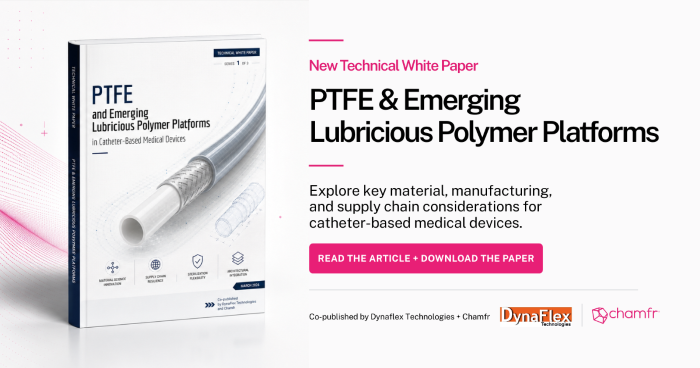
Explore PTFE performance, constraints, and broader material-selection factors such as bonding, sterilization, supply chain, and regulatory planning.
Read Technical Article
PTFE is replaceable in thin-wall liner applications. Learn why selecting a PTFE alternative can be a misleading approach.
Read Technical Article
Listen to Steve Maxson’s conversation with Ned Burnett, PhD, from Saint-Gobain about why polymer selection is one of the most important and under-discussed parts of modern MedTech device design.
Listen to the Podcast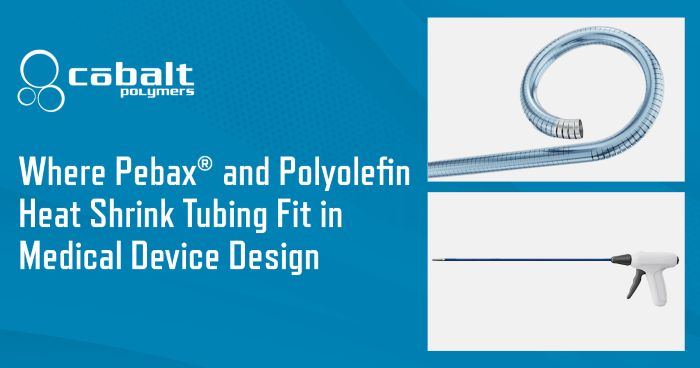
Learn where Pebax® and Polyolefin Heat Shrink Tubing fit in medical device design, including applications for laser-cut hypotube jacketing, electrical insulation, and four additional use cases in an in-depth guide.
Read Technical ArticleNot sure which path fits your project? Use these signals to decide.
Polymer tubing is used in catheter shafts, liners, delivery systems, fluid paths, insulation, protective components, and prototype assemblies.
Chamfr includes tubing across families such as Pebax, nylon/polyamide, polyurethane/TPU, PTFE, polyimide, polyolefin, PET/polyester, silicone/elastomers, radiopaque/tungsten-loaded materials, and specialty plastics.
Start With the Performance Need, then narrow by material family, grade, durometer, tubing type, dimensions, additives, supplier capability, and lead time.
Check material, grade, ID, OD, wall thickness, tolerance, length, durometer, additives, tubing type, MOQ or pack size, lead time, and documentation needs.
Pebax is commonly considered for catheter shaft sections and transition zones where a range of flexibility and stiffness may be needed.
PTFE is commonly considered for low-friction liner applications. Etched PTFE may be useful when bonding or over-jacketing is needed.
Low-friction Pebax, TPU, ProPell, EverGlide, Mobilize, and related lubricious compounds may be evaluated as alternatives to PTFE-lined constructions depending on the design requirements, bonding needs, shaft construction, and supplier documentation.
Common balloon tubing starting points may include nylon/polyamide, PET/polyester, Pebax, and TPU depending on balloon type, processing method, compliance needs, burst strength, wall behavior, and application requirements.
Submit an RFQ When you need a custom size, non-listed material, special construction, supplier review, production-volume sourcing, or documentation support.
Yes. Chamfr includes product listings intended to support prototype, feasibility, and early development needs, with RFQ available when listed options do not match your requirements.