

Predictive Modeling of Laser-Cut Hypotubes: Earlier Performance Insights for Catheter Design

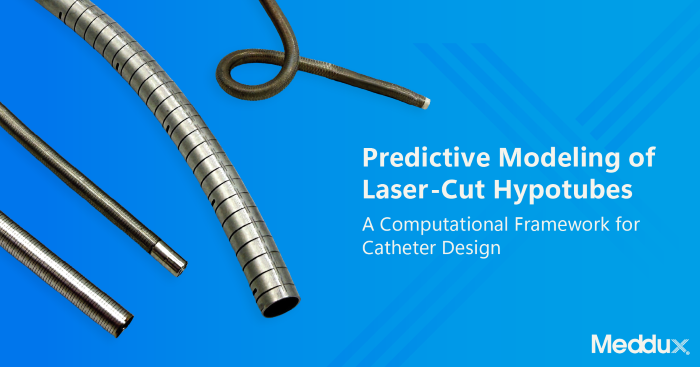
In this sponsored technical blog post, Meddux shares how predictive modeling can help catheter design teams evaluate laser-cut hypotube performance earlier, with an in-depth white paper on the computational framework, validation testing, and performance insights behind the model.
Laser-Cut Hypotubes and Precision Control
Laser-cut hypotubes have become increasingly valuable in high-performance catheter development, especially as minimally invasive procedures demand devices that can navigate complex anatomical pathways with precision and control.
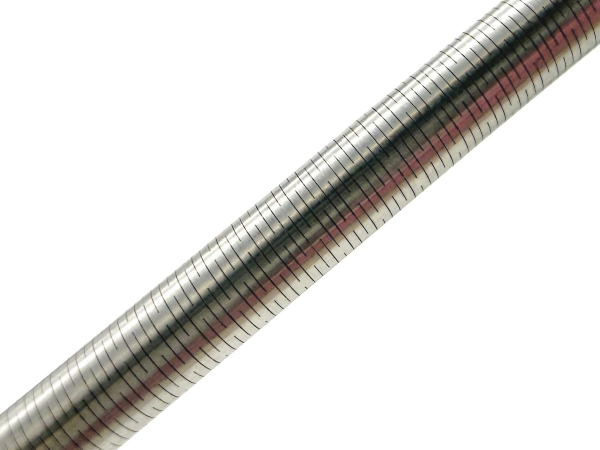
Compared to conventional braid and coil reinforcements, laser-cut hypotubes give MedTech development teams more flexibility to tune mechanical behavior through geometry. Cut patterns, pitch, kerf width, material selection, tube dimensions, and other design inputs can all influence how the hypotube bends, stretches, and transmits force.
That flexibility is powerful, helping engineers design for complex bending patterns, anatomical pathways, and operator control. But it also creates device design challenges.
The same geometry that makes laser-cut hypotubes so tunable can also make performance harder to predict before prototyping.
The question then becomes: how can you evaluate whether a laser-cut hypotube design is moving in the right direction early in development?
The Design Challenge: Predicting Laser-Cut Hypotube Behavior
With traditional braids and coils, engineers have access to more established tools and methods to help predict catheter performance.
Laser-cut hypotubes are different, as their performance depends on a complex mix of material properties and geometric inputs. Small changes in cut pattern, angle, pitch, cuts per revolution, tube length, or tube dimensions can affect rigidity and torsional response.
This can leave teams relying more heavily on iterative prototyping to understand how a design will behave.
In the white paper, Predictive Modeling of Laser-Cut Hypotubes: A Computational Framework for Catheter Design, Meddux addresses this gap through a predictive modeling framework developed in collaboration with the University of Colorado Boulder. It focuses on laser-cut hypotube mechanical performance, starting with the Interrupted Spiral cut pattern as a scalable foundation for future patterns.
This predictive capability has the potential to reduce reliance on iterative prototyping, helping bridge traditional engineering analysis with the demands of precision manufacturing.
From Engineering Inputs to Performance Characteristics
Meddux identified an engineering need for a computational model that enables quick iteration in software, instead of relying only on build-test-iterate cycles to understand design direction. They set out to create just that.
It includes a graphical user interface and a console-based calculator for real-time parameter assessment in both metric and imperial units, with longitudinal and flexural rigidity outputs.
Simply put, the model uses defined engineering inputs to predict key performance characteristics for laser-cut tubing, providing earlier visibility into the geometry and material choices that affect mechanical behavior.
Earlier Insights Before Prototyping
Predictive modeling doesn’t eliminate the need for testing, but it can help teams make more informed decisions earlier in development.
When MedTech teams working with laser-cut hypotubes can evaluate likely performance earlier, they can also:
- Compare design directions more efficiently
- Narrow the parameter space
- Better understand which inputs may have the greatest impact on device behavior upfront
Inside the Predictive Modeling White Paper
The full white paper provides a deeper technical breakdown of Meddux’s predictive modeling framework, including:
- The engineering challenge of predicting laser-cut hypotube performance
- The model architecture and input parameters
- Longitudinal and flexural rigidity prediction
- Tensile and three-point bend testing methods
- Validation results and accuracy thresholds
- Current model scope, limitations, and future development opportunities
Download the resource for a closer look at how predictive modeling can support earlier insights into laser-cut hypotube behavior and help guide early-stage design decisions for complex catheter systems and minimally invasive devices.
About the Supplier
Meddux is an expert guide for medical device development and contract manufacturing of complex interventional, minimally invasive surgical, and targeted delivery devices. With capabilities across user-centered design, product development, custom process development, and contract manufacturing, Meddux helps MedTech teams move complex device programs from concept to commercialization.