

 Share
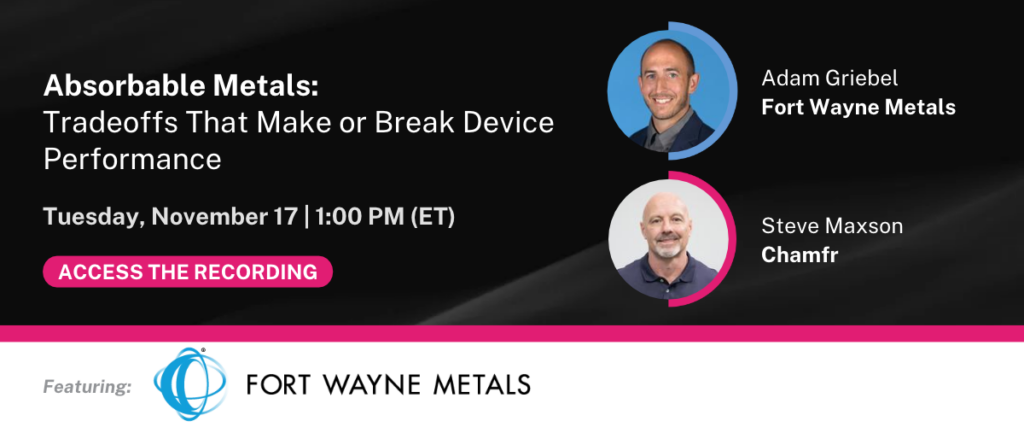
Absorbable Metals: Tradeoffs That Make or Break Device Performance
Compare magnesium, iron, zinc, and molybdenum across strength, degradation, and manufacturability, with firsthand R&D lessons to inform better material and design decisions.
A metal can have the strength your device needs and still be the wrong fit for an absorbable application.
Mechanical performance is only part of the equation. An absorbable material must provide the support a device needs, then degrade in a way that aligns with its intended function. However, before any of that matters, engineers need to know whether the alloy can actually be manufactured into the required form.
In this webinar, Adam Griebel, Principal Engineer, R&D at Fort Wayne Metals, joined Chamfr’s Steve Maxson to explore the engineering decisions behind magnesium, iron, zinc, and molybdenum.
From material selection and coatings to manufacturing limitations and degradation testing, the discussion made it clear why there’s not a one-size-fits-all approach to every absorbable device application.
Want the full session? Sign up to access the webinar recording →
No Single Absorbable Metal Checks Every Box
Magnesium, iron, zinc, and molybdenum offer different combinations of strength, degradation behavior, and radiopacity. But a property that makes one material attractive for an orthopedic implant may create challenges in a vascular device.
For example, magnesium can provide temporary structural support but may degrade too quickly for certain small-diameter applications. Iron-based alloys offer useful mechanical properties, although corrosion-related cracking and fragmentation can become concerns. Zinc introduces different mechanical limitations, while molybdenum offers high strength and radiopacity but degrades slowly.
The challenge isn’t simply identifying which metal performs best. It’s determining which combination of properties fits the device’s geometry, implantation site, functional lifetime, and manufacturing requirements.
Adam illustrates these tradeoffs through a neurovascular flow-diverter example, where strength, elasticity, degradation, and visibility must all be considered together.
Slowing Magnesium Corrosion Can Create a Different Problem
Magnesium is one of the most extensively explored absorbable metals, particularly for applications requiring temporary structural support. However, its relatively fast degradation can become a limitation when the device needs to maintain mechanical performance over a longer period.
Engineers have several ways to influence that behavior, including alloy composition, material purity, conversion coatings, and absorbable polymer coatings.
In the webinar, Adam shares an experimental comparison of bare, anodized, and polymer-coated magnesium wires after immersion testing. The results demonstrate how much a surface treatment can change corrosion behavior.
Slowing degradation isn’t automatically better.
A coating also has to match the device’s intended lifetime and mechanical requirements. A treatment that works well on a relatively rigid orthopedic component may not behave the same way on a structure that must expand, flex, or undergo significant deformation.
For engineers evaluating coatings, the important question is not only how effectively the coating slows corrosion, but whether it allows the device to perform as intended throughout its functional life.
The Iron Fragmentation Problem and a Molybdenum-Core Approach
Iron-based absorbable alloys can offer attractive mechanical properties, but their degradation behavior creates another challenge.
Unlike materials that degrade more uniformly, iron alloys can crack and fragment as corrosion progresses. In vascular applications, that possibility raises important questions about structural integrity during the absorption process.
Adam discusses an experimental approach developed at Fort Wayne Metals using its Drawn Filled Tube (DFT) composite-wire platform. The concept combines an iron–manganese-based outer layer with a molybdenum core.
The materials serve different purposes within the structure, with the composite approach being investigated as a way to address fragmentation concerns while also influencing degradation behavior and radiopacity.
It’s an example of how engineers may be able to work around the limitations of a single material through composite design.
A Promising Lab Alloy Still Has to Be Manufacturable
A material may demonstrate excellent properties in a university laboratory and still prove difficult to turn into a commercial medical device component.
As Adam explains, an alloy’s composition is only part of the story. The processing route influences its microstructure, mechanical properties, and degradation behavior.
An alloy that performs well in cast form, for example, might become too brittle when engineers attempt to produce wire or bar. Even when the desired geometry is achievable, manufacturing constraints can affect whether the process is practical and repeatable.
Magnesium presents some particularly interesting challenges. Its limited ductility can complicate deformation processing, and very fine magnesium wire can become difficult to handle and manufacture into assemblies such as braids.
Adam’s recommendation for early development is a practical one: test material in a form as close to the intended finished component as possible.
If the final device requires wire, evaluating wire earlier can reveal processing limitations that might not be apparent from testing cast samples alone.
For R&D teams, that can mean identifying manufacturing constraints before becoming too committed to a particular alloy or design approach.
How Much Can a Lab Corrosion Test Really Tell You?
One of the first questions engineers ask about an absorbable metal is also one of the hardest to answer: How long will it take to degrade?
The answer depends on more than the alloy itself.
Cross-sectional dimensions, implantation location, fluid exposure, and local conditions can all influence degradation. A material may behave differently in a high-flow vascular environment than in cortical bone.
That makes it difficult to translate a single laboratory corrosion rate into a reliable prediction of device lifetime.
Adam discusses the development of standardized approaches to absorbable metal testing, including ASTM F3268 and ISO/TS 20721. He also walks through an interlaboratory magnesium corrosion study that produced a range of results even when participating laboratories followed a common protocol.
This reinforces the importance of understanding both the capabilities and limitations of in vitro testing.
Laboratory methods can help compare materials and identify potential failure mechanisms, but connecting those findings to in-body performance requires additional evidence specific to the device and application.
Watch the Full Discussion: Engineering Absorbable Metal Devices
Selecting an absorbable metal means designing for properties that will change over time, while accounting for manufacturing constraints and the limitations of available test methods.
In the full webinar, Adam shares additional material comparisons, experimental images, manufacturing examples, and practical insights from his experience in R&D.
The session also includes audience questions covering device lifetime, DFT composite-wire alternatives, coatings, testing conditions, and material-processing challenges.