

Scale Catheter Builds With FEP Based Peelable Heat Shrink Tubing

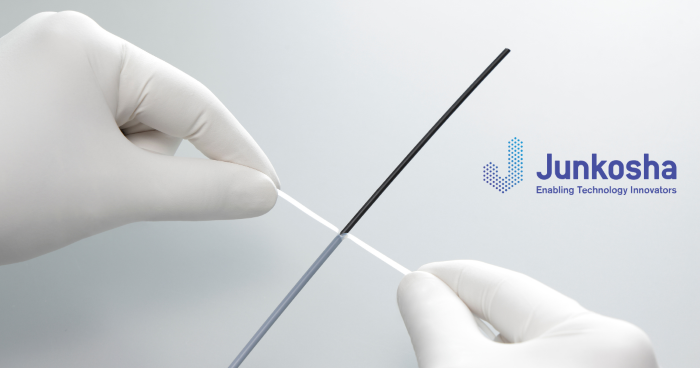
In this sponsored technical blog post, Junkosha shares why controlled peel behavior matters in catheter bonding, forming, and lamination processes, and how its FEP based peelable heat shrink tubing is engineered to support consistent removal, reduced process variability, and scalable catheter manufacturing.
Reducing Variability During Heat Shrink Removal
As catheter development and manufacturing becomes more complex and tightly controlled, engineers are under pressure to improve repeatability while reducing downstream risk. Bonding, forming, and lamination processes depend on stable thermal processing, but the removal of heat shrink tubing can introduce variability if peel behavior is inconsistent or difficult to control.
That variability matters. Thin-wall shafts, ultra-thin or compliant balloons, multi-layer laminations, and precision-formed distal features can all be sensitive to excess radial or transverse stress during heat shrink removal. Inconsistent removal can increase operator dependence, contribute to scrap or rework, and make it harder to scale a process from development to production.
Peelable heat shrink tubing helps address these challenges by enabling repeatable bonding, forming, and lamination processes while supporting controlled removal after thermal processing. Junkosha peelable heat shrink tubing, based on proprietary FEP technology, is engineered to deliver controlled, linear peelability along the catheter axis, supporting process consistency, improved yield, and scalable production.
For process, manufacturing, and R&D engineers in interventional, structural heart, and peripheral catheter manufacturing, Junkosha FEP based Peelable Heat Shrink Tubing functions as a process-enabling aid designed to support consistent manufacturing outcomes across complex catheter applications.
Engineering Intent: Peelability by Design
Peel behavior is not just a removal characteristic. In catheter development and manufacturing, it can influence process repeatability, part protection, operator workflow, and production scalability.
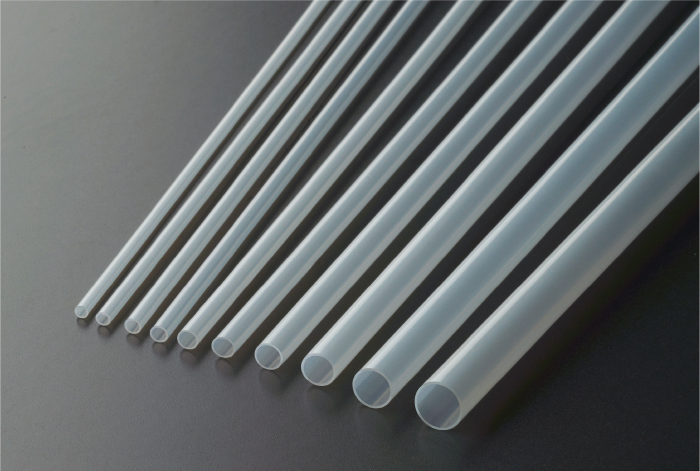
Junkosha FEP based Peelable Heat Shrink Tubing is engineered with peel behavior as a controlled mechanical performance characteristic. Through the optimization of fluoropolymer material properties and extrusion design, the tubing is designed to provide:
- Thermal stability during bonding and forming operations
- Uniform radial constraint across complex device geometries
- Controlled, low-risk mechanical removal after thermal processing
By controlling peel behavior at both the material and extrusion levels, Junkosha Peelable Heat Shrink Tubing delivers heat shrink performance that supports the dimensional, mechanical, and manufacturing requirements of advanced catheter assemblies.
Why Linear Peel Behavior Matters
Traditional non-peelable or manually slit FEP heat shrink tubing can introduce process variability through uncontrolled tear propagation, elevated radial or transverse stress, heavy operator dependence, and increased scrap or rework. Even peelable options with inconsistent behavior can undermine yield at scale.
For engineers building complex catheter assemblies, the risk is not only whether heat shrink tubing can be removed. It is whether removal can happen predictably, with minimal stress on the underlying assembly.
A controlled axial peel path helps reduce stress generated during removal and minimizes the risk of damage to thin-wall shafts, ultra-thin or compliant balloons, multi-layer laminations, and precision-formed distal features. Junkosha Peelable Heat Shrink Tubing is engineered to promote straight, axial peel propagation, helping teams reduce variability during one of the more sensitive steps in catheter production.
Balanced Mechanical Performance
Catheter development and manufacturing processes often require heat shrink tubing to perform in two ways that can be difficult to balance. During thermal processing, it must provide sufficient containment and radial constraint. After processing, it must be removable without introducing unnecessary stress or damage.
With Junkosha Peelable Heat Shrink Tubing, MedTech teams can balance:
- Hoop strength for uniform containment during thermal processing
- Controlled peel force for safe, low-effort removal
This balance supports stable bonding and forming processes while promoting consistent removal performance across manual, semi-automated, and automated manufacturing environments.
Application-Specific Manufacturing Value
Balloon Bonding
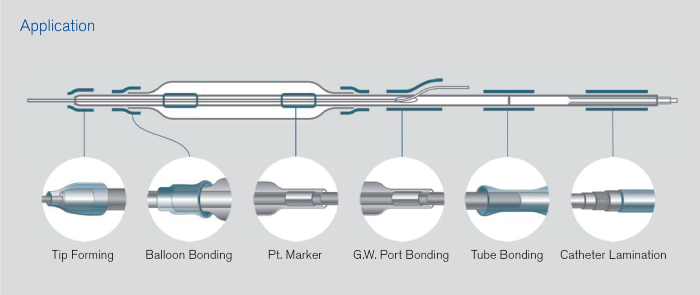
Balloon bonding requires reliable thermal processing and careful removal to help protect sensitive balloon structures. Teams require a uniform constraining force during thermal bonding and linear peel propagation, which helps reduce stress at balloon necks during removal.
This supports higher first-pass yield and reduced scrap in balloon bonding workflows.
Distal Tip Forming
During distal tip forming, maintaining component geometry through thermal processing is critical. Predictable peel behavior helps preserve formed features during removal and supports dimensional consistency of formed distal tip structures.
For engineers working with complex distal geometries, controlled removal can help reduce variability after the forming step.
Guidewire Port Bonding
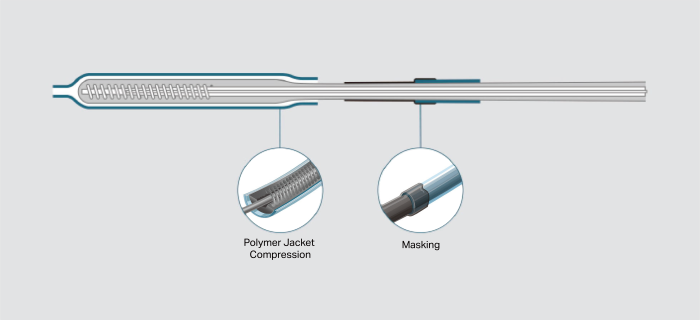
Guidewire port bonding can be sensitive to transverse stress during heat shrink removal. Axial peel propagation helps minimize transverse stress during removal and is engineered to maintain guidewire port integrity.
This also supports enhanced bonding process consistency across catheter manufacturing workflows.
Tube Bonding and Lamination
For tube bonding and lamination, consistent confinement across extended bond lengths can help support stable processing. A straight peel path also simplifies removal from long-shaft assemblies, helping manufacturers process bonded and laminated structures more efficiently.
This is especially important as catheter designs become more complex and teams work to standardize processes across operators, lines, and production sites.
Driving Manufacturing Efficiency, Safety, and Scalability
The controlled peel characteristics of Junkosha FEP based peelable heat shrink tubing are designed to reduce variability during heat shrink removal and support more standardized manufacturing processes. Linear peel behavior can eliminate the need for manual skiving, improving operator safety and simplifying removal procedures.
Predictable performance also supports process repeatability, process validation, global manufacturing transfer, and the implementation of automated production processes.
For engineering and manufacturing teams, this means that when Peelable Heat Shrink Tubing is engineered for controlled, linear removal, it becomes a process-enabling aid that supports consistency from development through scaled production.
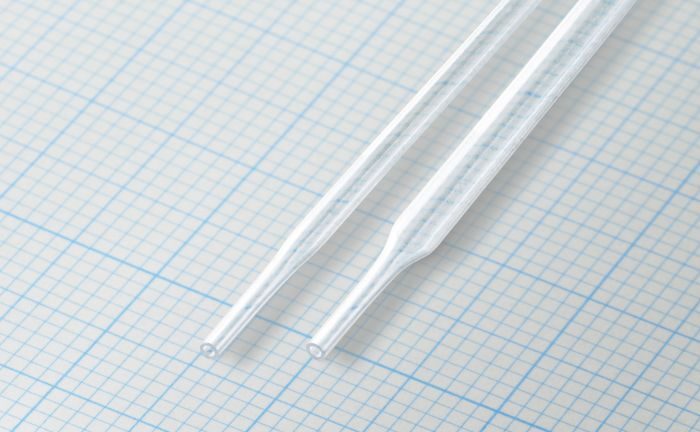
Consistency from Development to Production
Junkosha FEP based peelable heat shrink tubing is engineered to support modern catheter manufacturing through controlled linear peelability, balanced mechanical performance, and application-focused design. These characteristics help reduce process variability during heat shrink removal while supporting manufacturing consistency and production scalability.
In customer production environments where teams have replaced standard medical-grade FEP heat shrink tubing with this peelable HST, outcomes have included measurable yield improvements and increased operator confidence associated with more predictable removal characteristics.
For engineers seeking controlled, production-ready performance and a supplier with extensive fluoropolymer expertise, this option provides a robust solution for advanced catheter manufacturing applications.
FAQs
How long is the recommended usage of the Peelable Heat Shrink Tubing?
Please store the product unpacked and follow the recommended storage conditions. We recommend using the product within 6 months of shipment. Please use the product promptly after opening or if it has passed our recommended usage period.
What are the recommended storage conditions for Peelable Heat Shrink Tubing?
Store in a dark location below 30°C (86°F) and humidity must not exceed 85% relative humidity.
Has Peelable Heat Shrink Tubing been assessed for biocompatibility testing?
Yes, the product has been assessed for USP Plastic Class VI.
What is the recommended temperature when using Peelable Heat Shrink Tubing?
The recommended temperature when using Peelable Heat Shrink Tubing is 200°C (392°F). Maximum operating temperature is 240°C (464°F) depending on the product.
How much time is required for complete shrinkage?
Time required for complete shrinkage is about 30 seconds.
About the Supplier
Junkosha are pioneers of sophisticated fluoropolymer application technologies across various medical devices, semiconductor manufacturing and microwave interconnect sectors. With three operations in Japan, including its headquarters as well as sites in the US, UK and China, Junkosha is a trusted partner for innovation in advanced technology fields worldwide. The company provides tube and fitting products, including generic resin tubes, fluoropolymer tubes, high-barrier tubes, flexible multi-layered tubes, industrial hoses, degassing modules, heat-shrinkable tubes, and the market leading peelable heat shrink tubes.
Browse Junkosha’s in-stock peelable FEP heat shrink tubing on Chamfr →
Not finding what you’re looking for? Submit an RFQ to overcome your heat shrink challenges faster.