

Start Testing Catheter Tip Designs Without Waiting for Custom Tooling

Engineers often need to test catheter tip geometry before they’re ready to commit to custom tooling.
That puts tooling decisions early in development, when the design may still be changing. A standard die gives R&D teams a defined geometry to form and evaluate before the final tooling requirements are locked.
It also enables a more practical way to compare what happens as they adjust material, forming temperature, timing, or other process conditions. Instead of changing the tooling at the same time as everything else, engineers can work from a known geometry and focus on what those changes do to the formed tip.
Now on Chamfr, ONEX RF offers three in-stock catheter tip-forming dies for 4.5 Fr micro dilator, 4 Fr dilator, and 6 Fr sheath tip testing, all shipping in 1–2 business days.
Start testing sooner without making custom tooling the first step.
Three Geometries for Faster Sheath and Dilator Testing
Working on a micro dilator, dilator, or sheath? These three in-stock options give you a starting point based on the device and tube size you’re developing:
- 4.5 Fr micro dilator die with a 0.293″ taper
- 4 Fr dilator die with a 0.180″ taper
- 6 Fr sheath die with a 0.127″ taper
Each die gives engineers a known geometry to form, inspect, and compare while they work through the material and process variables that affect the finished tip.
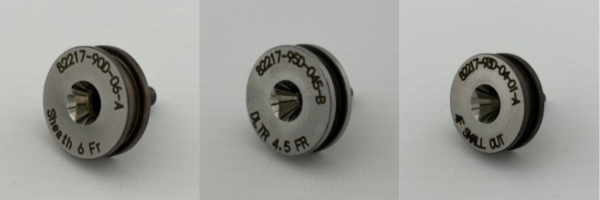
The different tube sizes and taper lengths also offer concrete starting points depending on the design requirements. Rather than beginning every test with a custom geometry request, teams can select the closest standard option, run the forming process, inspect the result, and determine whether the tip is moving in the right direction.
Forming temperature and material behavior can still vary based on formulation, size, hardness, and setup. A standard die won’t answer every process question, but it does give you a fixed tool geometry as you work through them.
Keep Tooling Consistent Between Tests
When you’re comparing changes in material, heat, timing, or tip geometry, keeping the tooling itself consistent from test to test is key.
Each ONEX RF die is made from hardened stainless steel with a polished ID, supporting repeatable development work as teams evaluate different forming conditions and tip designs.
That gives you a more controlled baseline for comparing results from one iteration to the next.
Each die also includes a 6-inch straight mandrel, another important part of the forming setup along with the die.
Choose the Heating Approach That Fits Your Setup
The dies support RF induction or hot-air heating, offering flexibility based on the equipment and forming approach you’re already using.
For RF induction, the die is used with an induction coil and a fixture or cassette. A thermocouple can also be used for die-temperature and process control.
Different tubing materials will require different forming temperatures based on formulation, size, and hardness, so engineers still need to dial in the process for the material they’re testing. The standard die keeps the geometry defined while those heating conditions are worked out.
When the Standard Geometry Isn’t Enough
A standard die can be a useful starting point, but it doesn’t always replace custom tooling.
If testing shows that the design needs a different taper, tip shape, tube size, or geometry, move into the next iteration with a clearer idea of what the tooling needs to accomplish.
From there, you can work with ONEX RF on custom tipping dies, process development, or proof-of-principle samples. Its broader tooling capabilities include tapered, chamfered, bullet-nose, rounded-edge, and soft-tip bond-taper geometries across tube sizes from 2 Fr to 40 Fr.
Explore ONEX RF tip-forming dies on Chamfr →
Have custom requirements? Submit an RFQ to share your device needs with ONEX RF.