

Low-Friction Polymer Compounds for Extruded Medical Tubing

Built-In Lubricity as an Alternative to Coatings and Liners
Lubricity is a critical performance attribute for interventional catheters and related medical tubing. Defined as slipperiness or smoothness, it is more commonly expressed in the medical device industry as the coefficient of friction (CoF), the ratio of frictional force to the normal force between two surfaces.
Low CoF reduces insertion and retraction forces, minimizes trauma to vessel walls, improves trackability and pushability, shortens procedure times, and enhances overall physician control and patient comfort.
Environmental factors such as moisture, temperature, and the nature of the contacting surface (tissue, guidewire, or mating device component) further affect real-world friction. Soft, flexible polymers commonly used in catheters, including low-durometer Pebax®, thermoplastic polyurethanes, nylons, etc., often exhibit inherent tackiness, making friction reduction essential.
PTFE remains the historical gold standard with a typical CoF of approximately 0.1 and is especially valued for enabling very thin-wall liners. For additional context, read our technical article on key considerations before replacing PTFE and Dynaflex’s white paper on rising PTFE constraints in catheter-based devices.
Medical devices are frequently delivered through long access paths and tortuous anatomy. As devices become more complex, the need for reliable lubricity increases to manage deployment forces, partial deployment/redeployment, and lower-profile designs.
Traditional Approaches to Reducing Friction in Medical Tubing
Historically, R&D engineers have relied on:
- Inherently lubricious materials such as PTFE or HDPE, typically incorporated as thin liners in multi-layer composites
- Hydrophilic coatings applied to the finished device surface
Hydrophilic coatings require water to activate, remain non-slippery when dry, and become a gel when wet.
Hydrophilic lubricious coatings typically rely on hydrogel polymers such as polyvinylpyrrolidone (PVP), polyacrylamides, or hyaluronic acid. When properly formulated and applied, best-in-class coatings can deliver greater than 10×, and in some cases greater than20×, friction reduction relative to uncoated surfaces. They can also maintain performance across a wide range of substrates, including various Pebax®, durometers, nylon, HDPE, and more.
Market expectations for these coatings include high durability under repeated cycling and tortuous-path use, low particulate generation, uniformity, biocompatibility, and compatibility with EtO, gamma, and e-beam sterilization.
These approaches call for careful engineering. MedTech teams need to consider coextrusion or surface etching to promote adhesion, delamination and particulate behavior during design verification, and evolving regulatory considerations around PFAS-containing fluoropolymers. Coatings also typically involve a secondary manufacturing step, which can add lead time and cost when devices are sent out for coating.
Where Liners and Hydrophilic Coatings Create Design Challenges
A particular challenge exists with inner lumen surfaces.
While lubricious coatings are readily applied to the outer surfaces of catheters and tubing, coating the inner lumen is significantly more difficult. Limited access for curing, challenges in controlling coating flow and uniformity, and the inability to directly inspect the cured result all create technical hurdles.
In delivery catheters, where interior lubricity is clinically critical, achieving a uniform, thin, and adherent inner coating remains technically demanding.
Low-Friction Compounds and Additives for Built-In Lubricity
A growing class of low-friction polymer compounds and masterbatch additives addresses these challenges by modifying the surface energy or frictional characteristics of standard medical-grade resins during compounding.
Proprietary additives are blended into the base polymer at relatively low loadings. The resulting compounds deliver permanent or durable lubricity on both the inner and outer surfaces of extruded tubing while largely preserving the bulk mechanical properties of the host thermoplastic.
Common lubricious compounds include Foster Corporation’s ProPell™, Compounding Solutions’ Mobilize, and Dynaflex Technologies’ EverGlide+. Typical additives used in these systems are siloxanes, hydrophilic polymers, and PTFE. Take a deeper dive into PTFE and emerging lubricious polymer platforms in our MedTech Unboxed podcast episode with Benny Cheung.
These platforms are typically compatible with radiopaque fillers, custom colors, and common sterilization methods. Many meet USP Class VI and ISO 10993 biocompatibility requirements and can reduce or, depending on the application, eliminate the need for dedicated lubricious liners or post-extrusion hydrophilic coatings.
This can be especially valuable for interior surfaces where coating application is difficult.
Because the lubricity is built into the resin itself, compounded tubing can be extruded, bonded, and shipped directly off the line with no separate etching or coating step required. That simpler process flow is a large part of why compounded low-friction tubing pairs well with in-stock and quick-turn sourcing, complementing coated options for programs where speed to prototype is the priority.
How Lubricious Additives Work During Extrusion
During extrusion, the additives migrate preferentially toward the surface, creating a concentration gradient. This produces a lubricated inner and outer surface while the bulk of the host thermoplastic remains largely unchanged.
The additive becomes entangled within the polymer matrix, helping lock the lubricious phase in place and contributing to long-term stability.
The Importance of Compounding Process Control
In polymer terminology, a resin is the natural, usually clear, polymer prior to any modification.
A medical compound is the finished material produced by melting and mixing that resin in a co-rotating twin screw extruder, blending it with additives, such as lubricious agents, pigments, radiopaque fillers, or stabilizers, and pelletizing the result.
Proper dispersion of the lubricious additives and any radiopaque fillers or colorants is critical.
Poor dispersion can cause surface imperfections, reduced yields, and higher manufacturing costs.
Knowing the target wall thickness of the final tubing is important because it influences both filler loading levels and the optimized compounding process needed to achieve uniform dispersion.
Independent evaluations of extruded tubing incorporating such additives consistently demonstrate measurable friction reduction, good dimensional stability, retention of key mechanical properties, and compatibility with secondary operations such as bonding and printing.
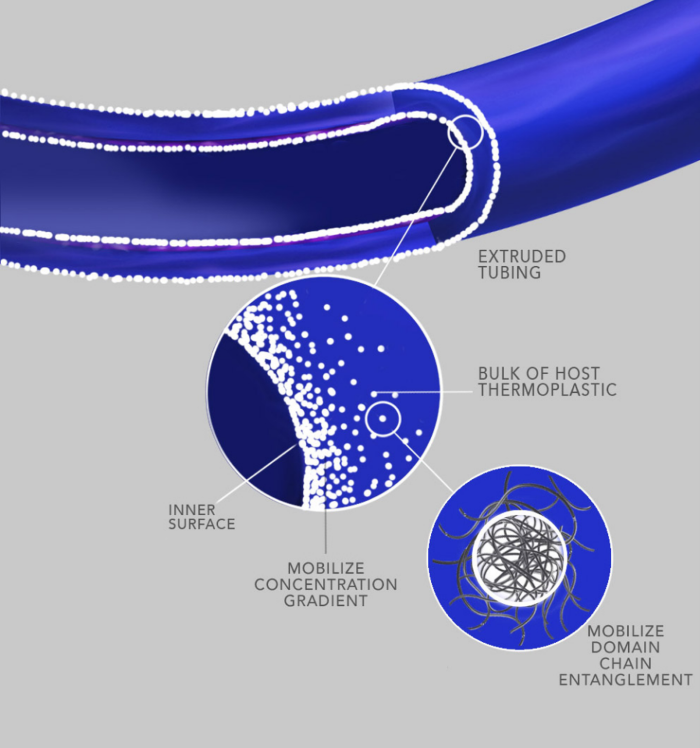
Image: Compounding Solutions
Next-Generation Applications for Low-Friction Polymer Tubing
Beyond conventional catheter tubing, low-friction compounds are opening new design possibilities in more demanding or specialized medical components.
Medical Balloons with Inherent Lubricity
Traditionally, medical balloons are formed from balloon tubing extruded from natural (unmodified) polymers such as Pebax®, nylon, or TPU.
By instead extruding the balloon tubing from a lubricious compound, the finished balloon itself can deliver inherent lubricity. This approach offers the potential to reduce or, in some cases, eliminate the need for a secondary hydrophilic coating after balloon forming.
It can simplify manufacturing, lower particulate risk, and maintain the compliance and thin-wall performance required for balloons while providing clinically relevant lubricity.
Prior art has also explored semi-compliant balloons formed from polymer blends engineered to deliver inherent surface lubricity without a separate coating layer.
Film-Cast Ultra-Thin-Wall Structures
Film-casting of Pebax®, TPU, and nylon is already a well-validated process for producing ultra-thin medical tubing.
Ongoing developments are focused on solutionizing lubricious compounds based on these same base materials so they can be used in film-cast processes. This would enable ultra-thin structures with inherent low-friction performance, supporting PFAS-free low-friction composites as well as thin-walled medical components that require both extreme thinness and durable lubricity.
Key Takeaways for Low-Friction Medical Tubing
Low-friction polymer compounds offer a practical way to achieve reliable lubricity while simplifying manufacturing. By integrating lubricity directly into the material, engineers gain greater freedom while reducing process complexity and cost.
These capabilities increasingly extend to next-generation applications such as medical balloons and ultra-thin film-cast structures.
Ready-to-Ship Low-Friction Medical Tubing on Chamfr
Chamfr supports rapid prototyping and early-stage evaluation with a substantial inventory of ready-to-ship low-friction and lubricious medical tubing. This includes nearly 500 SKUs of EverGlide+-based extrusions as well as multiple ProPell™-based options, including single-lumen liners and jackets across a range of durometers, IDs, wall thicknesses, and lengths.
Engineers can also find complementary PTFE, PEBA, nylon, multi-layer, and other lubricious tubing across multiple suppliers, available to order on one PO. Most ship in 1–2 business days, enabling fast iteration without custom compounding lead times.
Browse in-stock low-friction polymer tubing or submit an RFQ for specialized configurations.
Not sure which material or construction fits your application? The Polymer Tubing Guide walks through materials, constructions, specs, and RFQ paths to help narrow down the right fit faster.
FAQs: Lubricious Polymer Compounds
How do lubricious polymer compounds work?
Lubricious polymer compounds use additives that migrate toward the tubing surface during extrusion. This creates lower-friction inner and outer surfaces while largely preserving the bulk mechanical properties of the host polymer.
How are low-friction compounds different from hydrophilic coatings?
Hydrophilic coatings are applied after manufacturing and typically require moisture to activate. Low-friction compounds build lubricity into the resin itself, which can simplify processing and help address surfaces that are difficult to coat, such as inner lumens.
Where are lubricious compounds used in medical devices?
Lubricious compounds can be used in catheter tubing, liners, jackets, medical balloons, and ultra-thin tubing or film-cast structures where durable lubricity and manufacturability are important.
Why are inner lumen surfaces difficult to coat?
Inner lumen surfaces are difficult to coat because access is limited, coating flow and uniformity are harder to control, curing can be challenging, and the finished coating may be difficult to inspect directly.