

5 Medical Device Development and Manufacturing Takeaways from MPP East

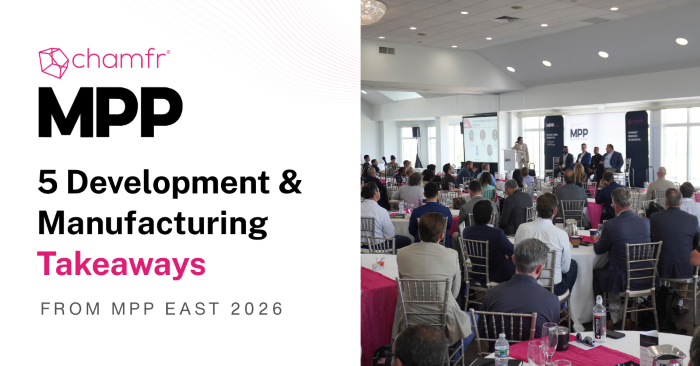
The path from medical device development to manufacturing rarely moves in a straight line.
A prototype may perform exactly as intended, only for new questions to surface as volumes increase, manufacturing processes change, or materials vary.
Those realities shaped many of the technical conversations at MPP East 2026.
Across the discussions on injection molding, catheter production, medical tubing, Nitinol, materials, process development, and scale-up, speakers kept returning to a common challenge:
What works in development still has to work in manufacturing.
For R&D, product development, process engineering, and manufacturing teams, that means understanding not only whether a design can work, but how quickly and reliably it can be produced as the program moves forward.
Explore five takeaways that surfaced across the conversations at MPP East, and join us for what’s next in Ireland and Minnesota.
1. Medical Device Prototyping Should Test the Process, Not Just the Part
A prototype answers a critical product development question: Does the part work?
But moving toward production introduces another: Can the manufacturing process make that part consistently?
During the Injection Molding Process Optimization & Scaling panel, one speaker captured that distinction clearly.
Proving the part works is not the same as proving the intended production process.
A prototype may use different cooling, runner layouts, tooling configurations, cavity counts, or other process conditions than the eventual production environment. As a result, successfully producing a prototype does not necessarily mean the same design will transfer smoothly into higher-volume tooling.
The panel discussed taking prototyping further by mimicking more of the intended production process, particularly when moving toward high-cavitation tooling. That can help teams identify risks before making a much larger tooling and validation commitment.
A working prototype proves the design can work. A stronger development process also starts proving how it will be made.
2. Catheter Manufacturing Scale-Up Can Expose Hidden Yield Risk
Strong yields in development can create confidence that a process is ready to scale. But those early results may depend heavily on the experienced engineers building the devices.
During the Scaling Catheter Production panel, one speaker described catheter manufacturing yield during scale-up as a U-shaped curve.
During feasibility and validation, experienced catheter engineers are building the product themselves. They know the equipment and technology, and they’re operating without the same takt-time and cycle-time pressures found in production.
Early yields can therefore look very strong. Then the program scales.
Volumes move from hundreds of units into thousands. Processes transfer from catheter engineers to operators. Production expectations change.
That’s where MedTech teams can experience a sudden drop in yield.
Over time, as the manufacturing process matures, yield can recover and potentially exceed what was achieved during development. The challenge is controlling that drop and accelerating the return to a capable, repeatable process.
This raises an important question: Is the process inherently robust, or are experienced engineers particularly good at making it work?
Understanding the difference earlier can help teams shape a more realistic path from development to production.
3. Design for Manufacturability Starts Earlier Than Many MedTech Teams Think
Medical device development teams often approach a program with different priorities.
R&D may be focused on maximizing device performance. Operations may be focused on yield, efficiency, and process repeatability. Program teams may be pushing to move development forward faster.
The challenge isn’t that those priorities are incompatible. It’s that the teams responsible for them may not begin working together early enough.
During the UMass Lowell Plastics Engineering discussion, one speaker argued that these conversations should begin in phase zero, before phase one: “Amazing things happen when people talk to each other.”
Involving operations and suppliers earlier in development, before decisions become difficult or expensive to change, is a valuable design-for-manufacturability (DFM) principle.
DFM isn’t simply a review performed after the design is nearly complete. For complex medical devices, manufacturing knowledge can help shape decisions around materials, tolerances, processes, inspection, tooling, and scalability upfront.
The earlier those perspectives meet, the more opportunity teams have to challenge assumptions before they become problems later in production.
Dive deeper into this topic in our DFM technical article and webinar with Jacob Gibb of Intuitive Surgical, where he shares a practical perspective on optimizing collaboration between OEMs and CDMOs to scale faster.
4. Medical Tubing Extrusion Has to Work Beyond the CAD Model
A drawing can specify a dimension. CAD can model a geometry. But neither automatically means the selected manufacturing process can produce it reliably.
The High-Performance Medical Tubing & Extrusion panel delivered one of the clearest themes of the day: “Just because you can put it on SolidWorks doesn’t mean you can extrude it.”
The conversation focused on balancing what appears on a drawing with the realities of material and process capability, making communication between design, prototype, and production teams especially important in medical tubing development.
For R&D engineers, that doesn’t mean reducing device requirements simply because something is difficult to manufacture. It’s about understanding which requirements are genuinely critical to device performance, how those requirements interact, and what the selected process can repeatedly deliver.
A tolerance can be technically possible and still create unnecessary manufacturing difficulty. A geometry can exist in CAD and still require changes to become a repeatable extrusion. And a specification only becomes useful when development and manufacturing teams understand what it means in practice.
5. Nitinol Performance Depends on Processing
Material innovation is creating new opportunities in the MedTech industry, but that does not eliminate the importance of processing.
During The Future of Nitinol panel, one speaker made that point directly: “You can have a really clean alloy, but if you don’t process it correctly, you’re not going to get that performance benefit out of that alloy.”
The discussion then moved into how Nitinol itself is evolving. The panel described a shift from more conventional, broadly applied alloys toward cleaner materials, finer grain structures, and potentially more dedicated alloys designed around particular performance requirements.
Fatigue life and radiopacity were among the characteristics discussed as the industry considers more application-specific material approaches.
Increasing Nitinol knowledge and demand may also create more opportunity to invest in new alloy development, including superelastic materials that move beyond traditional approaches.
Overall, teams should be asking which material characteristics and processing approaches best support what the device needs to do, especially as devices become smaller and more complex.
Learn more in our webinar with Lighteum Medical and RBP Chemical Technology, Beyond the Surface: The Hidden Science of Nitinol Electropolishing.
Medical Device Development and Manufacturing Need to Stay Connected
Across injection molding, catheter manufacturing, medical tubing extrusion, and Nitinol processing, the conversations at MPP East repeatedly pointed toward similar development challenges:
- A functional prototype does not guarantee production capability
- High development yield does not guarantee high-volume yield
- A CAD model does not automatically reflect process capability
- A high-quality material doesn’t deliver its full performance independent of how it’s processed
- Development decisions become harder to change the further a program progresses
The strongest programs are not simply designed and then handed over to manufacturing. R&D, product development, materials, processing, operations, manufacturing partners, and specialized suppliers all bring experience and knowledge that influence what happens well before production begins.
Join the Conversations at MPP Ireland and MN
MPP is built for teams solving today’s MedTech challenges and shaping the future of device development, manufacturing, and processing. Combining expert-led technical discussions with hands-on learning and meaningful networking, the goal is simple: Actionable insights. Global perspectives. Stronger connections.
Join the conversation with product development, process engineering, OEM, CDMO, and supplier leaders at the next two MPP events:
MPP Ireland is on September 22 in Galway, the day before Medical Technology Ireland, with panels spanning smart catheter technologies, wire and braiding, polymer processing, balloon catheter technologies, laser processing, surface solutions, and medical polymers.
Shortly after, MPP MN will be held the day before MD&M Midwest on October 27 in Maple Grove, continuing the series with a different agenda focused on areas including device-development pathways, catheter and device scalability, polymer processing and in-process measurement, fluoropolymers, supply-chain resilience, precision metals, and advanced machining.
Both will include live equipment demos, workshops, and the opportunity for women across every career stage to join the Advancing Women in MedTech Mastermind Meetup the day prior.
Whether you’re local or traveling in, come ready to compare notes, challenge assumptions, and take something useful back to your team.